
Saturday, 22 July 2023
Thursday, 13 July 2023
STAR TREK: STRANGE NEW WORLDS Review: "Charades"
STAR TREK: STRANGE NEW WORLDS Review: "Charades"
blog.trekcore.com
“Charades” is an enjoyable homage to 1960s screwball sitcom hijinks that is undercut by the rather shaky (and increasingly annoying) science fiction trope about splitting a multiracial person in two. This is not to say that the episode handles that topic itself that badly, but I’ll get into that later.
Enterprise is on a slow cruise through the Vulcan system on its way to the moon of Kerkhov, home to an ancient civilization that could be the site of great archaeologic discovery. The downtime is great for the crew, especially Nurse Chapel (Jess Bush), who is preparing to interview for an internship with the great Dr. Roger Korby on Vulcan. She is, however, pointedly avoiding Spock (Ethan Peck), who is also doing his best to avoid her in return.
Spock has been busying himself with work and preparing to meet T’Pring (Gia Sandhu) and his future in-laws for a Vulcan engagement ritual. It is, as they say, “a big thing” – though not, apparently, as big a thing as Spock having to take Chapel along as a passenger when they do a shuttle flyby of the Kerkhovian moon. It’s painfully awkward… right up utnil an anomaly above the Kerkhovian ruins snags the shuttle and gives it a good ol’ Star Trek zap.
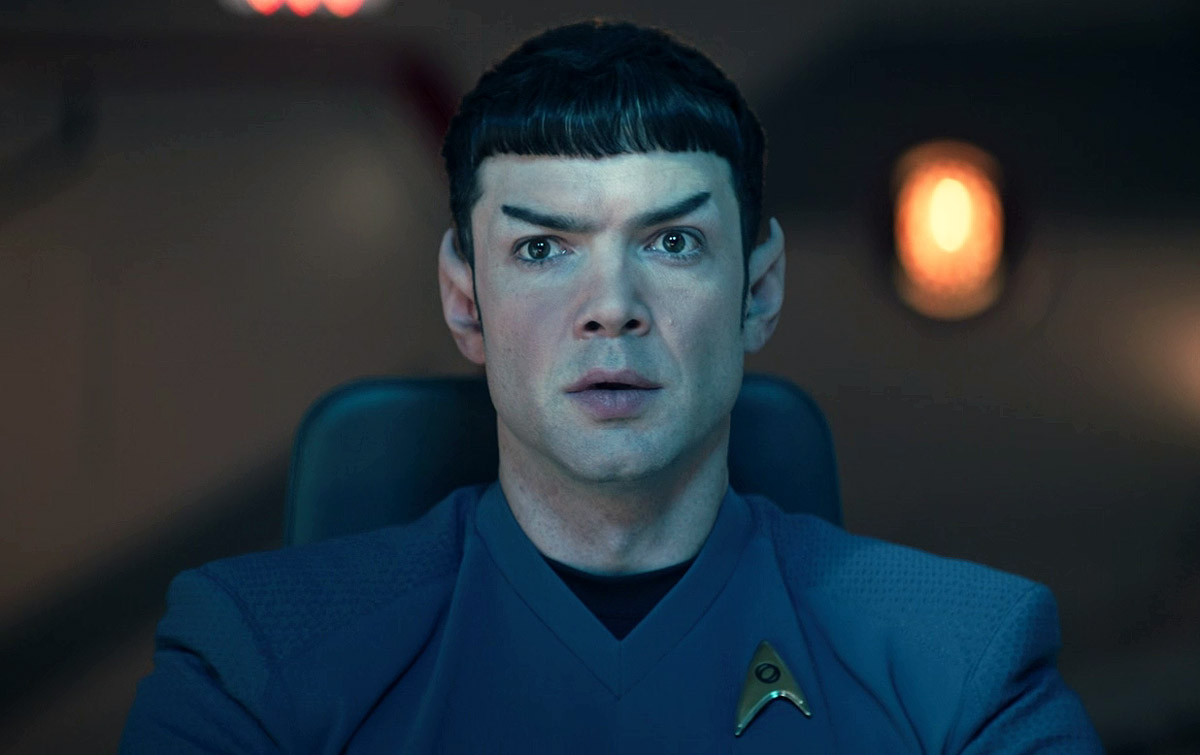
Thankfully, Spock wakes up on the Enterprise, seemingly unharmed… until the reveal that he’s now fully human! We learn that the energy-based Kerkhovians tried to repair Spock’s injuries from the shuttle accident, and found his Vulcan DNA to be an anomaly — comparing him to the all-human Chapel — and “helpfully” removed that part of his genome before returning the shuttle back to normal space.
Honestly, I can live with this interdimensional-being nonsense as an explanation for this, even if it is kind of stupid. Thankfully, no one aboard the Enterprise is even trying to argue that this could be a benefit to Spock — but he’s stuck like this for now, since the Kerkhovians seem to be unwilling to “heal” him another time.
And what does it mean for Spock? Seemingly, he’s not only lost his Vulcan genome, but he’s apparently lost his capacity to act like a Vulcan as well, missing all of those inherited cultural suppressants that Vulcans have. Ethan Peck gets to show off his comedy chops in a reasonably funny montage of Spock managing his new human forms of expression — including laughing, irritation, and alarmingly… bacon.
I like the idea that human emotionality is just too constant for Spock — and like any adolescent Spock must learn to tame them, much to the consternation of the crew.. thought I wonder how exactly La’an (Christina Chong) became the one to give him “the talk.”
Meanwhile, Chapel has her own problems: her interview with the Korby fellowship is a disaster, as the Vulcan Science Institute has little time for her fieldwork and “interpretation.” Spock offers some comfort in a very un-Vulcan way. (He’s learning to cope.)
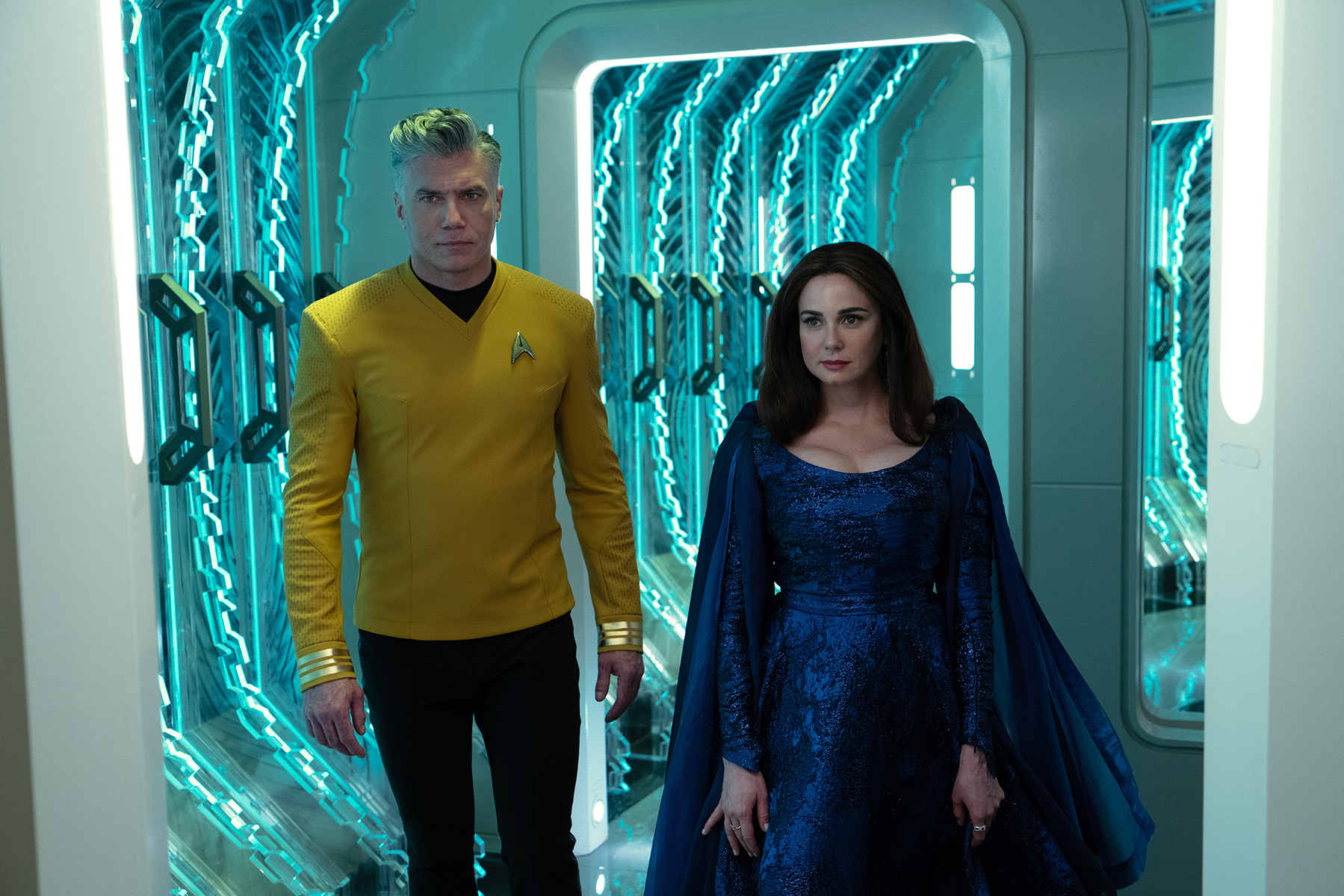
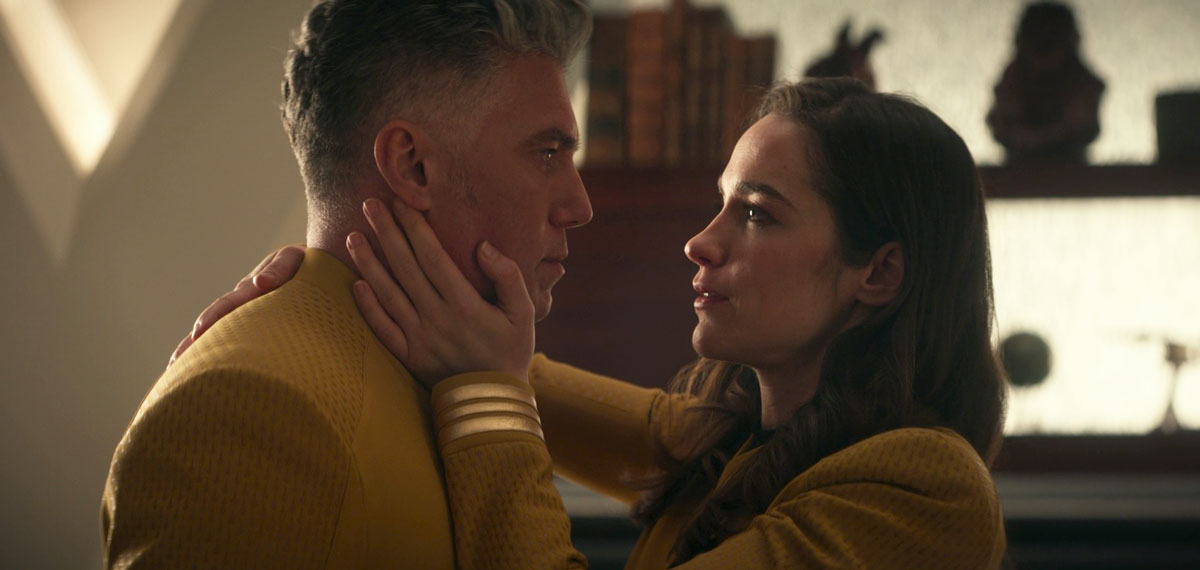
Their brief reunion is interrupted by the appearance of a new problem: Spock’s mother Amanda Grayson (Mia Kirshner) arrives, only to report that the engagement dinner is going to happen aboard the Enterprise!
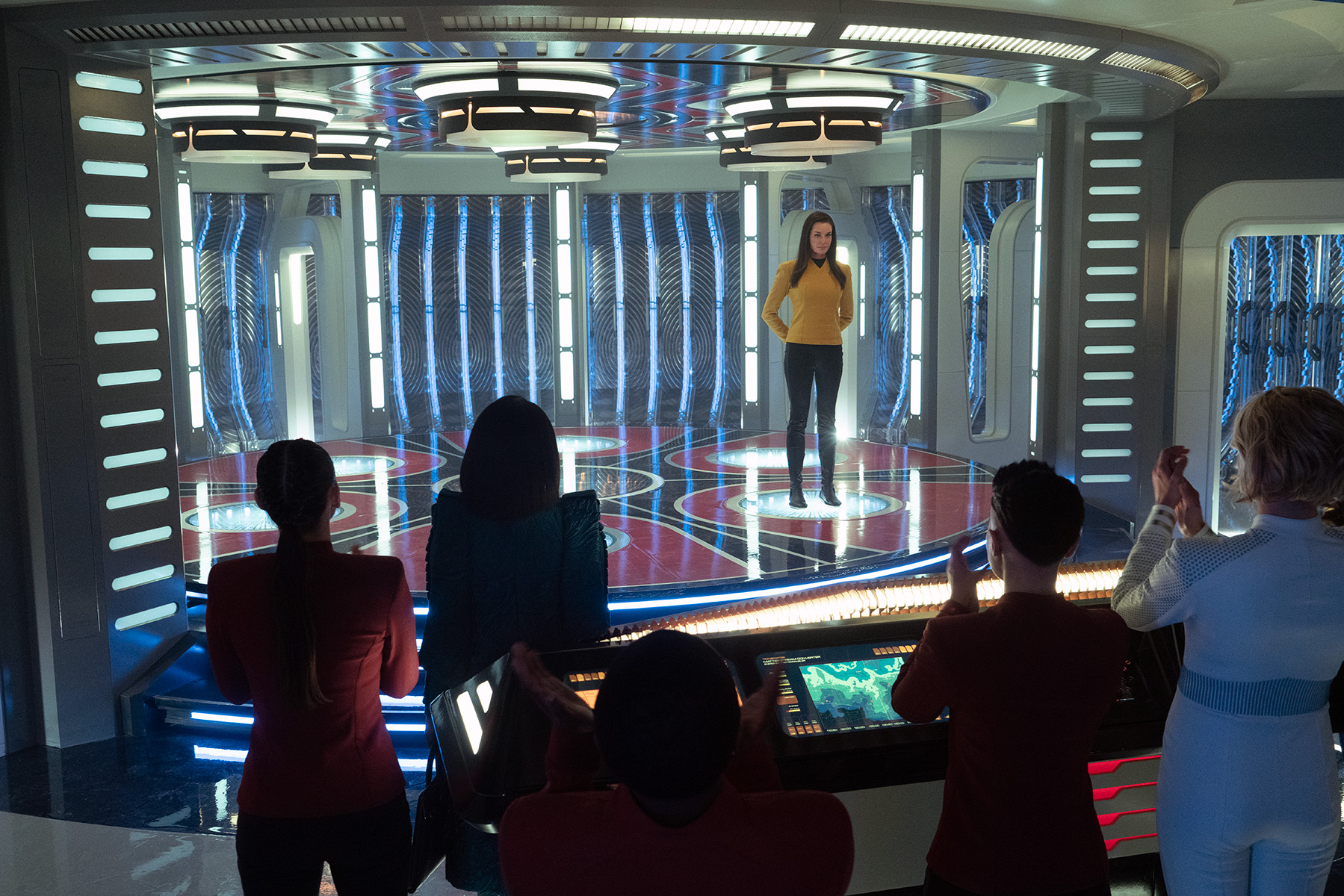
Kirshner’s return after a four-year absence is a delight. Her interpretation of Amanda, last seen in Discovery’s “Such Sweet Sorrow, Part 2,” was brilliant and nuanced, and taking the opportunity to bring her back here was perfect. Amanda’s grace and wit, as well as her motherly tendencies towards Spock, are the perfect foil for Peck’s frantic, teenager-esque characterization of the now-human Spock — the sequence in the transporter room when Spock and Pike (Anson Mount) try to hide the predicament from her is brilliant.
With the tenuous relationship between Spock and T’Pring’s families on the line, the natural (and most hijink-heavy) choice is for Spock to finally learn the most important human characteristic of them all: how to lie to your in-laws! With coaching from both Amanda and his cremates, Spock must learn how to present as a typical Vulcan: handling superheated teapots, talking with the monotonous tone of logic, and trying (and failing) to manage his emotional outbursts during a V’Shal “improvement” session and a bogus mind-meld.
Things look dicey, butthe show must go on. After Chapel is unable to find a cure for his condition using Federation technology, she ropes in Uhura (Celia Rose Gooding) and Ortegas (Melissa Navia) into her mission to fly back to the Kerkhovians and demand that they take another look at Spock. In the meantime, T’Pring returns ahead of her difficult parents, as Spock does his best to act Vulcanly-normal. He succeeds in that feat, but fails to do the more important thing: tell her what’s going on.
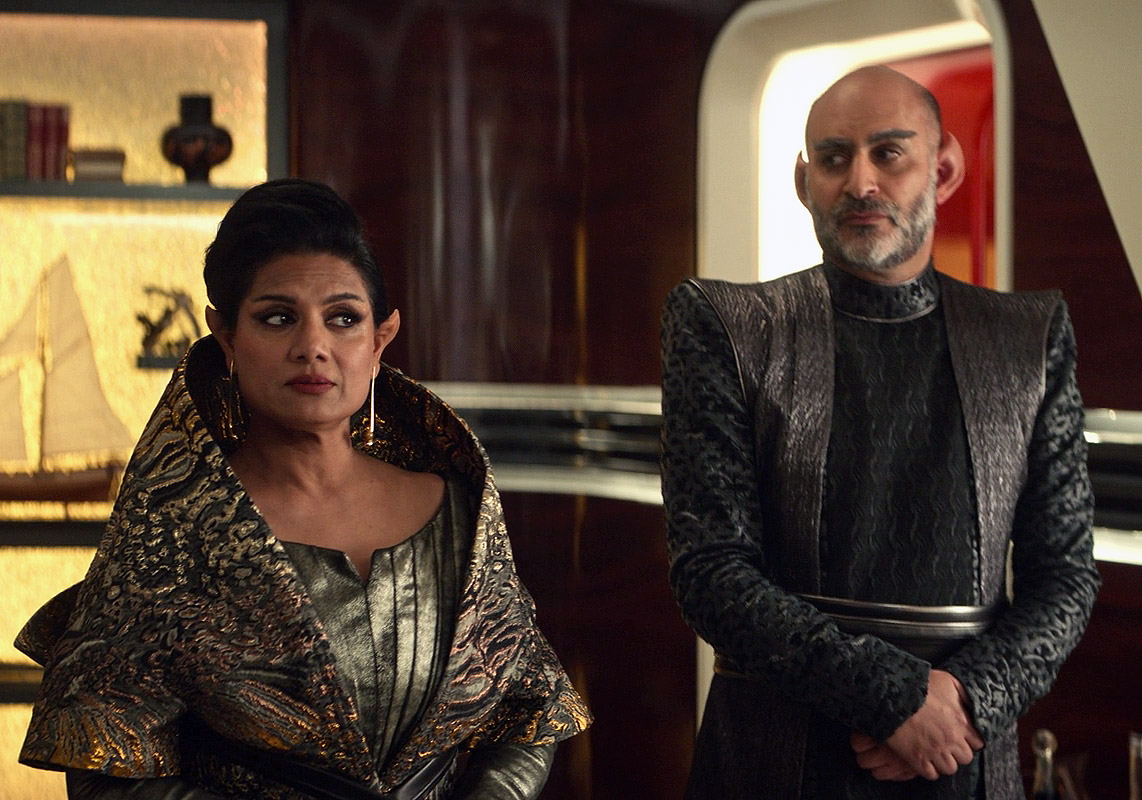
T’Pril (Ellora Patnaik) and Sevet (Michael Benyaer), T’Pring’s terrifying parents, are great! They are not complicated characters in any sense; drawn more from the cookie-cutter in-law stereotypes of The Dick Van Dyke Show, I Love Lucy, and Bewitched era, but with a Vulcan twist. And honestly? It works!
The whole set-up is a perfect storm of 60s sitcom tropes: the disapproving mother-in-law, the contrived rituals that have to be absolutely correct, the awkward doing-his-best host (Captain Pike), the easy to please but doting husband in Sevet. They are not particularly deep characters, but they are interesting; certainly T’Pril’s aloof arrogance towards strangers — and family — explains a lot about T’Pring’s own temperament.
As Spock claws his way through the rituals, Chapel, Ortegas and Uhura make their way to the Kerkhovian moon. Unable to ring through, Uhura suggests “wedging the door open” with a shuttlecraft, which seems to get the Kerkhovian’s attention. Unfortunately, they still don’t understand what they’ve done wrong, even as Chapel insists that they fixed him incorrectly.
Back on the Enterprise, the ritual only gets worse as they enter the “improvement” stage, which seems to mainly consist of T’Pril being mean to everyone in the room — but primarily Spock, who she eviscerates as being wholly inadequate for her daughter. T’Pril’s attitude is characteristic of a lot of Vulcans we’ve met over the years, and if we are to assume that this viewpoint is fairly normal among the Vulcan population (as we’ve seen again and again), it certainly underlines the difficulty and nuances of Spock’s dual identity.
Spock himself struggles a lot here, and I do to. T’Pril sucks; her attituded towards Spock’s complicated identity is infuriatingly realistic and recognizable to many people, and the way in which you just have to put up with it, even when you know it shouldn’t be how things go.
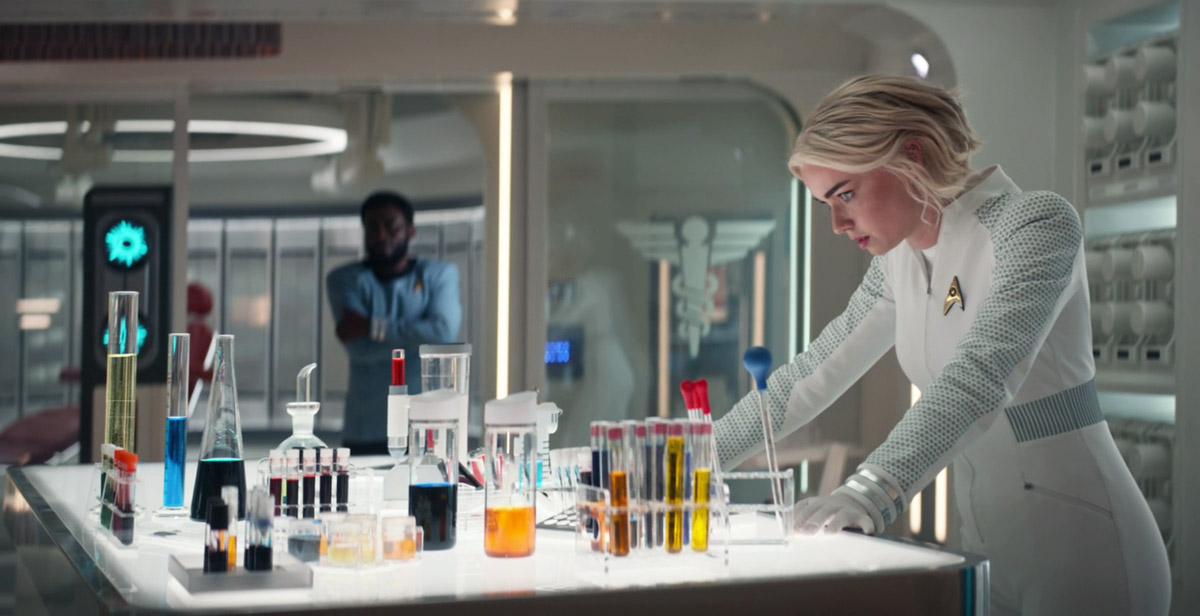
The tone stays with us as we go back to Chapel, Ortegas and Uhura. Stuck in interdimensional space, Chapel pleads with the Kerkhovians to fix Spock, but they remain unconvinced.. though not as unconvinced as Ortega and Uhura about Chapel’s “just friends” claim when it comes to Spock. As Chapel pleads for their action, the Kerkhovians (and her friends!) force her to confront how she feels about Spock in the open, and how important he — all of him — is to her.
With time running out before the fateful and un-fakeable mind meld, Pike attempts to stall with an ancient Earth ritual: charades! This gives Chapel just enough time to arrive with Spock’s much-needed “vitamins.” In the bathroom. Yeah, I can understand T’Pring’s suspicions, even if Chapel is only there to fix Spock before either of them can act on their impulses.
With his internal Vulcan genetics restored, Spock can mind-meld with his mother, sharing the memory of school day; finally, it appears that T’Pril is content with Spock… until she shares her own bigoted views on Spock’s “faults,” pointedly marking down his human side for its inability to conform to Vulcan ritual.
This gives Spock the opportunity to reveal that he’s been human the entire time, thanks to the timely removal of his fake ears. It’s a nice moment, especially for the support Spock shows to Amanda for putting up with the absolutely nonsense that people like T’Pril throw at her. Since “Journey to Babel,” there has always been this undertone in Amanda’s character that she has to suffer through a lot of Vulcan bigotry to get by as Sarek’s wife, and the overt acknowledgement of that is a good writing moment.
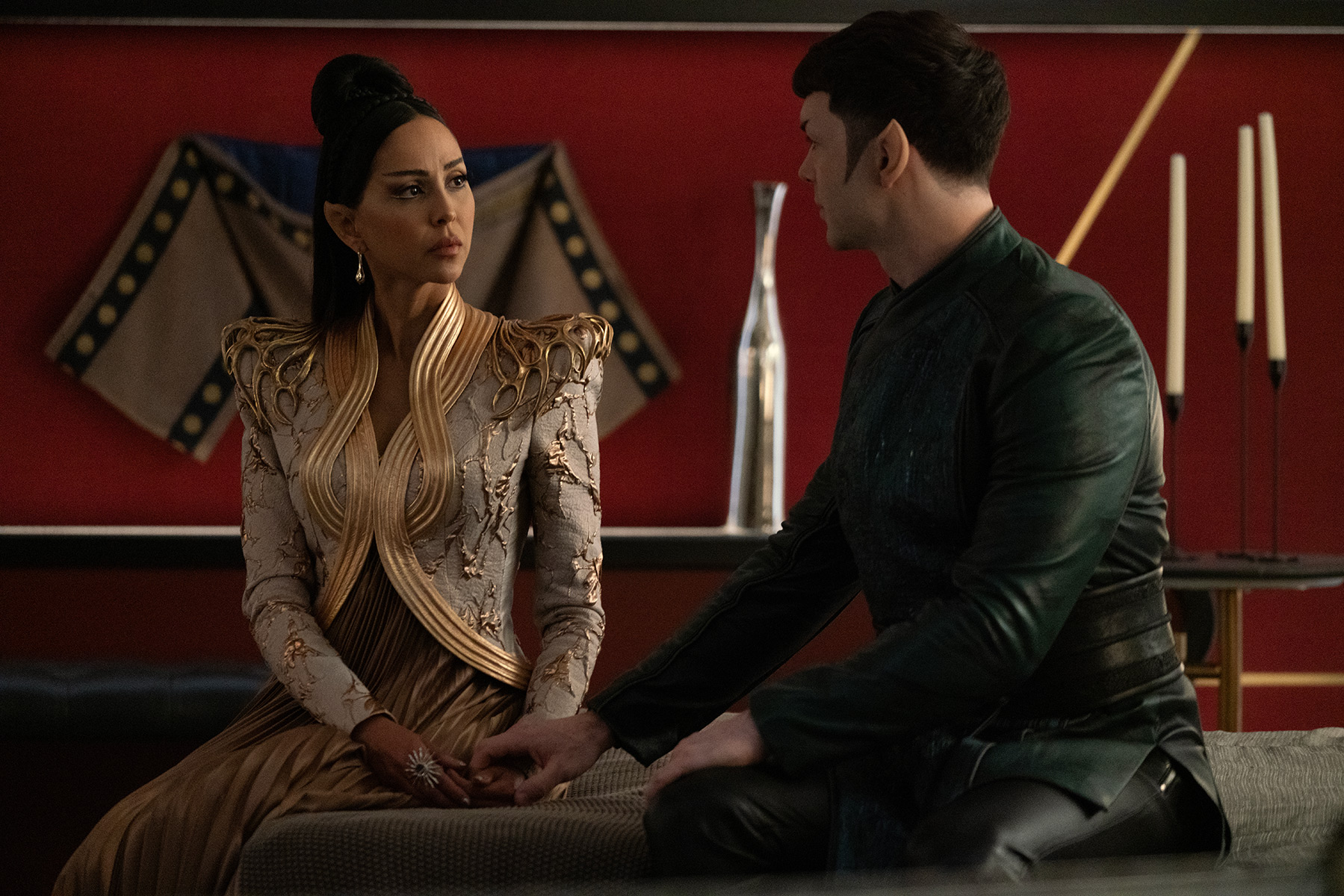
The aftermath of the reveal is a little laboured. Spock is back to normal, but his relationship with T’Pring is significantly damaged. Unhappy that everyone on the ship — except for her — seems to have known about his predicament, she decides that now that they’ve appeased their families, they should probably spend some time apart. Which, sure. That will help.
Spock’s own conflict is helped in some way by the final conversation with his mother. The details on the memory they shared in the mind-meld — of the first time Vulcan children let Spock play with them — is bittersweet, especially as they discuss how difficult Amanda’s time was.
Then, of course, Chapel and Spock face up to each other’s feelings. Events have forced each of them to face what the other feels, and what they represent to each other. It goes about as well as you’d expect, with the will-they-won’t they of the last 10 episodes finally reaching some catharsis. I guess someone out here was asking for this — I certainly wasn’t — but it seems that Strange New Worlds has committed to the pairing… at least, until Roger Korby comes into the picture.
“Charades” is just fun! It’s also a well-written comedy that doesn’t treat the allegorical bigotry lightly, even if that part of things could have been handled a bit more seriously. But this wasn’t a serious episode, and it’s quite clear that we really shouldn’t think too hard about the dynamics of Vulcan biology or Kerkhovian medicine; it’s just a show, we should really just relax.
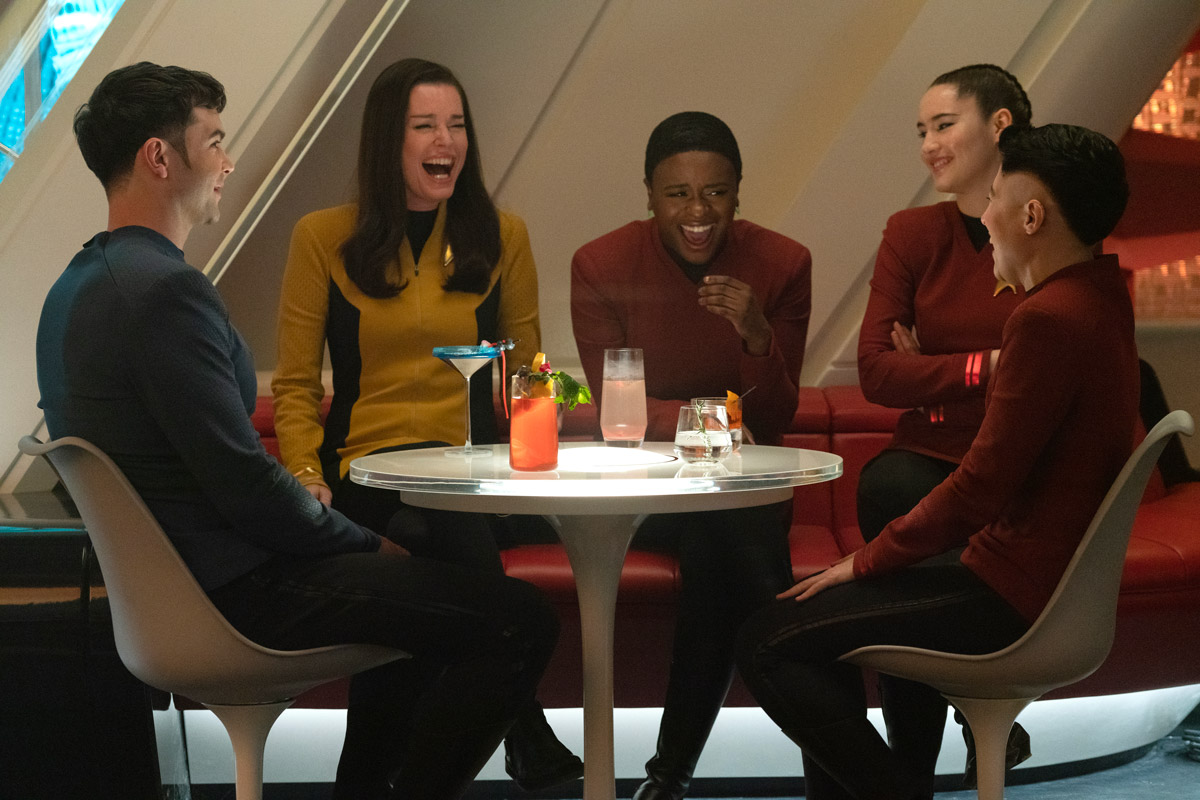
That said, there are definitely some points that I need to talk about, given how this episode treated Spock’s multiracial identity. Since the the first preview clip for “Charades” dropped last week, there’s been a significant level of discourse in some circles around the idea of splitting Spock — or the idea that you can make a mixed-race person into “one or the other” genetically.
Speaking as a mixed-race person myself, someone who has had their identity essentialized to one half or the other by different people through my life, that’s not fun, and it’s not something to encourage or support. “Charades” doesn’t support that essentialism: the whole idea that the Kerkhovians can “remove” his Vulcan genetics is annoyingly supported by Trek canon — the Vidiians did it to B’Elanna Torres in “Faces — but unlike that nightmare of an episode, we’re not dealing here with a character lamenting their dual heritage.
The entire character of T’Pril exists to remind us how narrow-minded that sort of viewpoint is, and how Spock cannot be boiled down to being “Vulcan enough” for his mother-in-law. We’re not meant to agree with her viewpoint, and we’re not meant to think the Kerkhovian’s “remediation” is acceptable at any level. Despite that text, however, I am so tired of this trope — because even subversion and criticism of splitting a multi-racial person means accepting that in Star Trek, such a thing is possible. You can’t split me into an Irishman and a Trinidadian; that’s not how I work. Even if you could put me in a transporter and beam the “Irish” out of me, you’d still end up with… me.
And I think the episode does that, in a sense — altered Spock still has all of Spock’s own personality quirks, his awkwardness, his curiosity and his temperament — but in other ways, it feels off. This Spock is meant to be wrong. He’s meant to be incomplete and unformed; as La’an says, he’s closer to an adolescent teenager than anything else.
I didn’t find this episode’s set-up particularly offensive, but this trope needs to be put to bed. As much as the conflict between his human and Vulcan “halves” is interesting, I think exploring that internally is much more interesting than exploring them in this external manner.
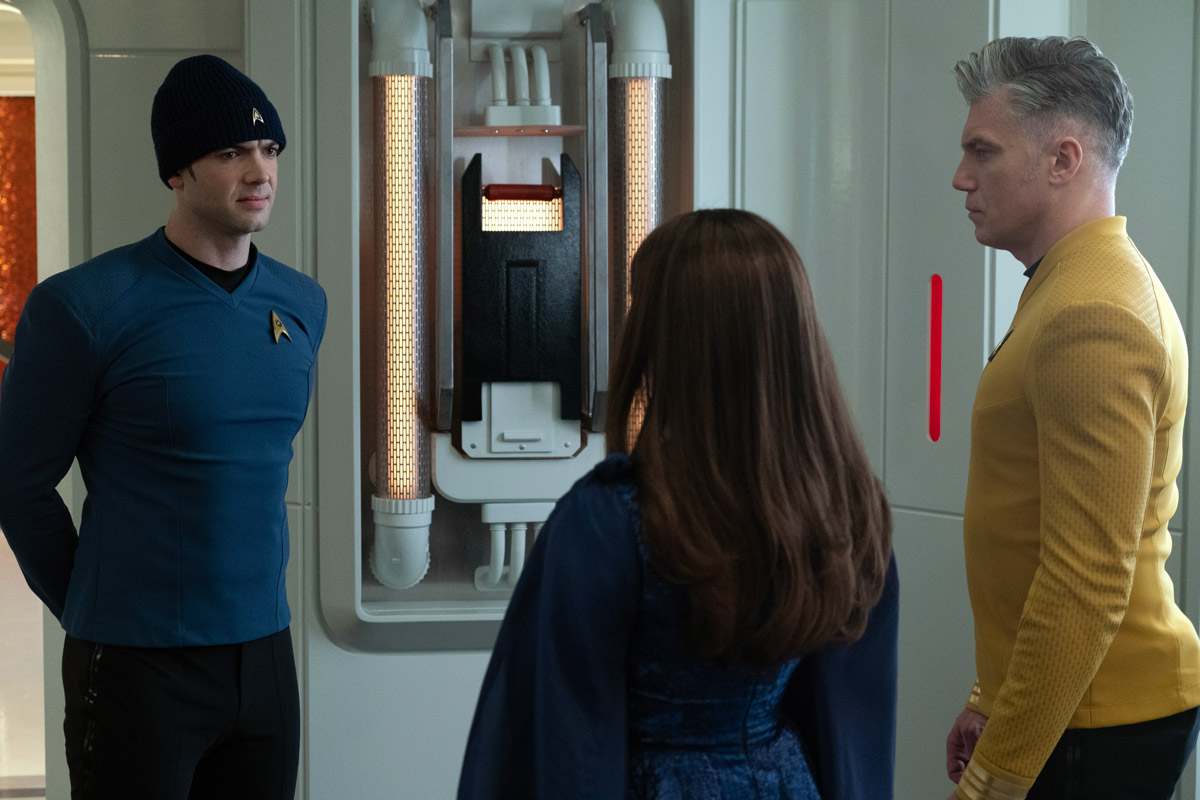
CAMP NONSENSE OF THE WEEK
There were plenty of contenders this week! Strong consideration went to Pike’s contorted looks of pain throughout the entire V’Shal ceremony — and to the bridge crew coaching Spock on how to ‘speak Vulcan’ — but this week we have to give it to Ethan Peck’s performance.
He managed to bring plenty of hilarity in his de-Spock-ified performance, but never lost science officers key characteristics.
OBSERVATION LOUNGE
- This episode brings us the first Strange New Worlds-era mention of Dr. Robert Korby, who would eventually become Christine Chapel’s romantic partner and fiancé in the years ahead of “What Are Little Girls Made Of?” Considering other developments in Chapel’s love life, I am intrigued as to how he’ll fit in here.
- The episode also mentions the ongoing rift between Spock and Sarek, which won’t be resolved until “Journey to Babel” — an episode set eight years into the future.
- Spock’s hat ploy with his mother is a clear homage to the multiple occurrences of Vulcan ears being hidden with beanies or other caps, though this time with a twist: it’s to hide his lack of pointed ears.
- Pike’s wearing the green wrap again, but this time it appears with a more formal look. I hope every season has a “Spock hijinks and green wrap” fifth episode!
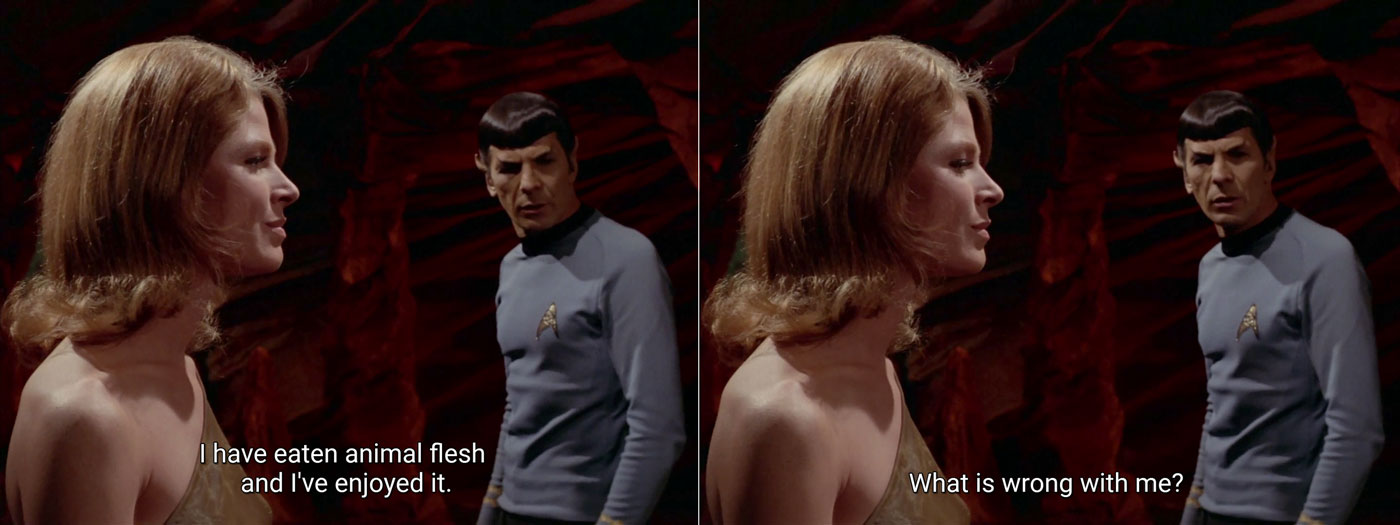
- Pike’s delight at watching Spock taste bacon — while a funny moment — seems a bit cruel, given how much we know about how much Vulcans detest eating animal flesh.
Once again, the Strange New Worlds cast proves that they can do comedy just as well as they do drama, all without losing the edge on the more serious elements of the plot. Even as someone who does not enjoy this whole Spock/Chapel thing, it’s well-scripted and well-acted; Bush and Peck sell the romantic tension and awkwardness, and the payoff at the end is earned.
I am interested in long – and how far – the writers intend to go with this, considering that this relationship can’t last too long with with what we know about Chapel’s romantic future. Having T’Pring break things off with Spock because he can’t confide in her also works well; you can see how this will lead to her attitude in “Amok Time” already.
Star Trek: Strange New Worlds returns with “Lost in Translation” on Thursday, July 20 on Paramount+ in the U.S, the U.K., Australia, Latin America, Brazil, France, Italy, Germany, Switzerland and Austria.
Thursday, 6 July 2023
STAR TREK: STRANGE NEW WORLDS Review — "Among the Lotus Eaters"
STAR TREK: STRANGE NEW WORLDS Review — "Among the Lotus Eaters" • TrekCore.com
blog.trekcore.com
“Among the Lotus Eaters” feels like an Original Series episode — not in a “classic Trek, top-ten-memorable moments” sense, but more of a “well, at least they tried something new” sort of way. (Think “For the World is Hollow and I have Touched the Sky,” but with a shorter title.)
The Enterprise and Cayuga, Captain Batel’s (Melanie Scrofano) ship, on a joint operation to survey a pair of pulsars, which is a nice opportunity to Captain Pike (Anson Mount) and Batel to catch up on some much needed personal time. Batel gifts him an Opelian mariner’s medal, a pendant she picked up on Galt, when their time together is interrupted by professional calls — including a longwinded conversation with Admiral Eldon.
It appears that Batel is being punished for Una’s acquittal in “Ad Astra per Aspera,” as she learns othe, with promotions passing her for other candidates. Pike seems to blame himself, and tries to push her away… something Batel doesn’t take well.
Thankfully, Starfleet has given Pike a distraction from post-breakup moping: a mission to Rigel VII, site of a disastrous landing party six years ago. Photoreconnaissance of the pre-warp planet has revealed a dangerous anomaly: a Starfleet delta sculpted into gardens surrounding the royal palace. With a likely Prime Directive violation the cause, Pike and the Enterprise must return to the planet to correct their own mistake.
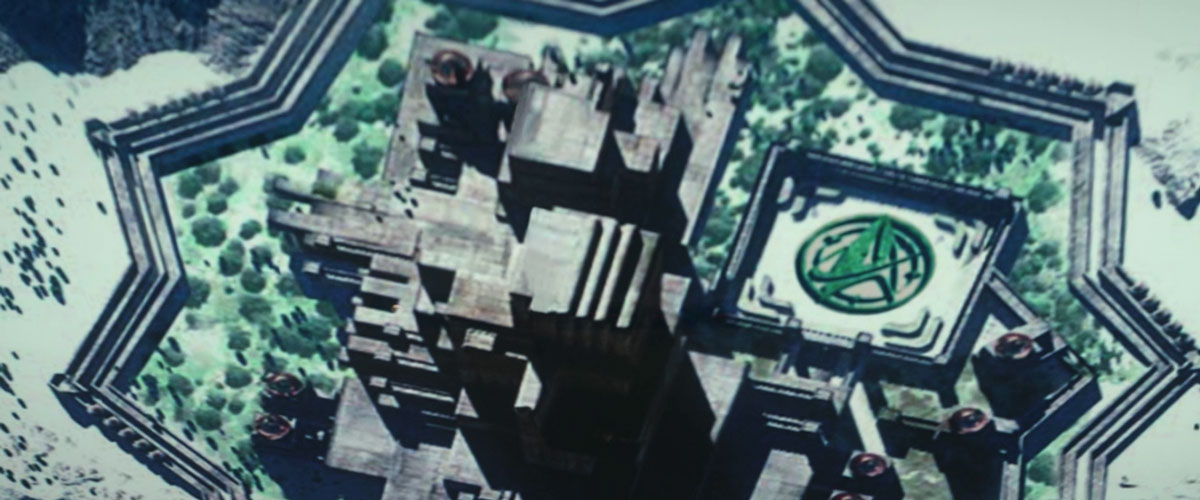
It’s an interesting pitch for a plot, and certainly a captivating one, as Pike’s existing melancholy mood over the cultural contamination is a nice character reach back to the brooding captain of “The Cage.”
Pike, La’an (Christina Chong), Dr. M’Benga (Babs Olusanmokun) and plucky navigator Lt. Erica Ortegas (Melissa Navia) prep to join the landing party, dressed in culturally-appropriate costuming. Ortegas is excited to finally join an away mission, but her excitement to get out into the field is quickly dashed when her piloting skills are required to keep the Enterprise safe from a nearby asteroid field.
The remaining trio descend to the planet, departing their shuttle on foot towards the palace with only the appropriate technology — only for La’an to inexplicably lose six hours worth of her memories of the journey. It’s very odd, but M’Benga can’t immediately discern a medical cause, and the trio push forward. Arriving at the palace, they find another Starfleet delta on the exterior gates, along with phaser-rifle-carrying guards.
It’s clear sign of technological disruption, but as Pike and the team start to formulate a plan of entry, they’re ambushed by phaser-toting warriors who recognize them as Starfleet personnel.
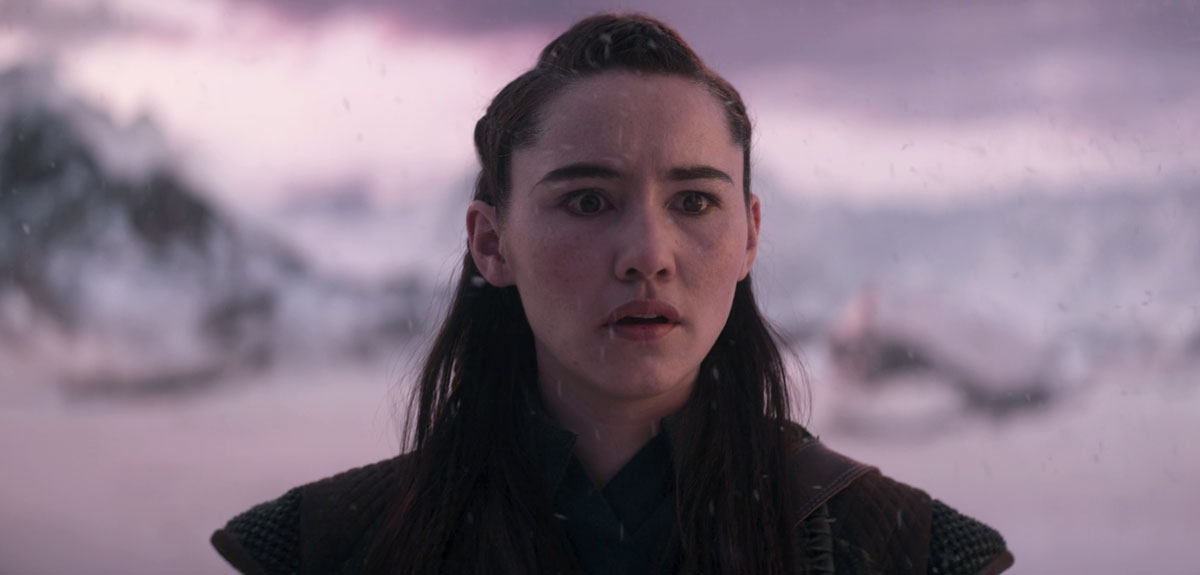
It’s now M’Benga’s turn to experience memory loss, and when he recovers, the landing party is about to be hauled in front of the “High Lord” of the region, a sovereign who turns out to be Zach (NAME), a member of the Enterprise landing party thought dead during Pike’s last visit to Rigel VII, furious about being left behind.
Zach reveals that Rigel VII “changes people,” as a nearby asteroid — one of which crashed to the planet’s surface nearby — emits a dangerous form of radiation that erases one’s memory completely. While Pike, La’an, and M’Benga forget their identities quickly, the radiation soon begins to affect the Enterprise crew as well as Uhura (Celia Rose Gooding) is one of the first aboard ship to experience memory loss.
Back on the surface, an older man called Luq (Reed Burney) approaches Pike in an effort to help the landing party through their “Forgetting.” Pike and La’an attempt to overpower the guards, which goes well until La’an is stabbed. M’Benga tries to help, but she is dying; Luq takes then to his house, where they will be safe for the time being.
There’s something very TOS-esque about the Forgetting, along with the local color-based caste systems, the totems, the four guards in the hats, and the sets where you can clearly see the back wall. (Was this a purposeful homage? Quite possibly? Did it still feel very shallow? Absolutely.)
The acting is great, especially as Pike remembers his emotional connections to La’an, M’Benga, Batel and the ship in orbit, but the storytelling is still closer to the sophistication of “The Apple” than anything with depth. That’s fine, if you can live with that. I think with 50 years of hindsight, I’m struggling a little.
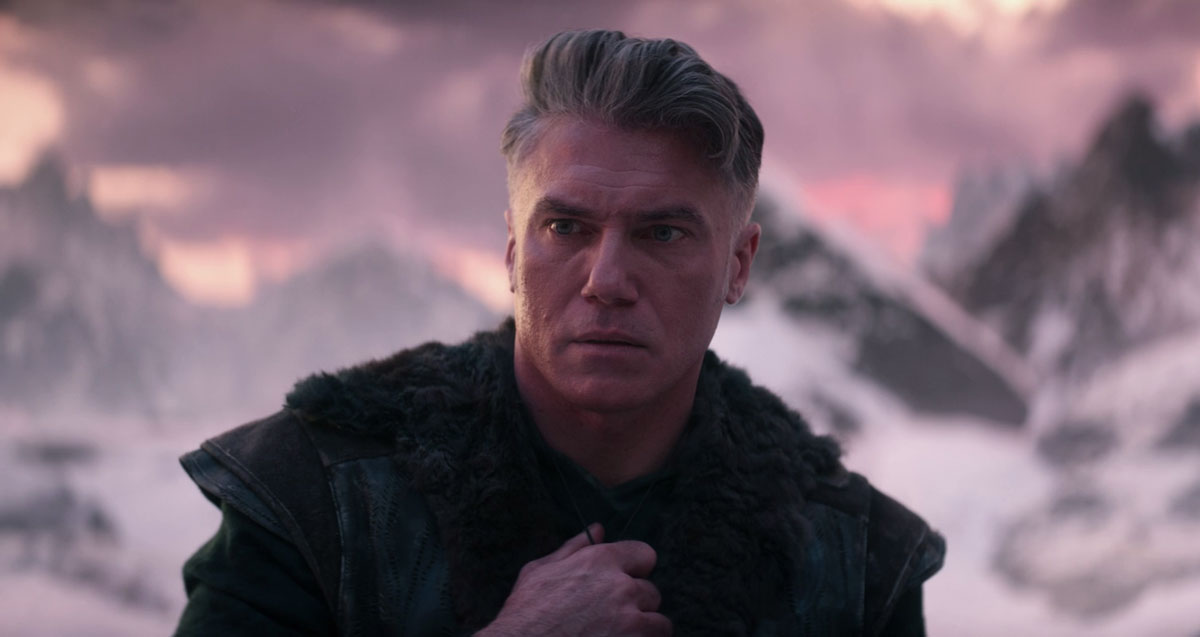
On Enterprise, the memory loss is growing; a third of the crew is down, with more to follow. It appears that Rigel VII is the cause, with exotic radiation emitted from its atmosphere as the culprit. Spock (Ethan Peck) and Ortegas — the last crew left on the bridge –- makes the drastic move of taking the ship into the asteroid belt in the hopes that minerals in the field will protect them.
Back on Rigel VII, Pike argues with Luq about whether or not it is better to save La’an — or let the “forgetting” take her memory from them — which is a grim and very TOS idea in a way. Even the language Luquses feels like a TOS homage, as he talks about leaving behind the burdens of past pains every night. Luq knows he had a family, but they are forgotten and he prefers it that way.
Pike isn’t convinced; he knows must save La’an and get back to whoever gave him that medallion — Batel. This seems to convince Luq; apparently love is an emotion so strong the Forgetting can’t erase it. (How convenient!) M’Benga thinks he can save La’an if he gets his memories back, and the totem in Luq’s home says that the palace contains a casket that holds peoples’ memories — this keeps the king and warriors to keep their memories intact, while those outside the palace walls must forget.
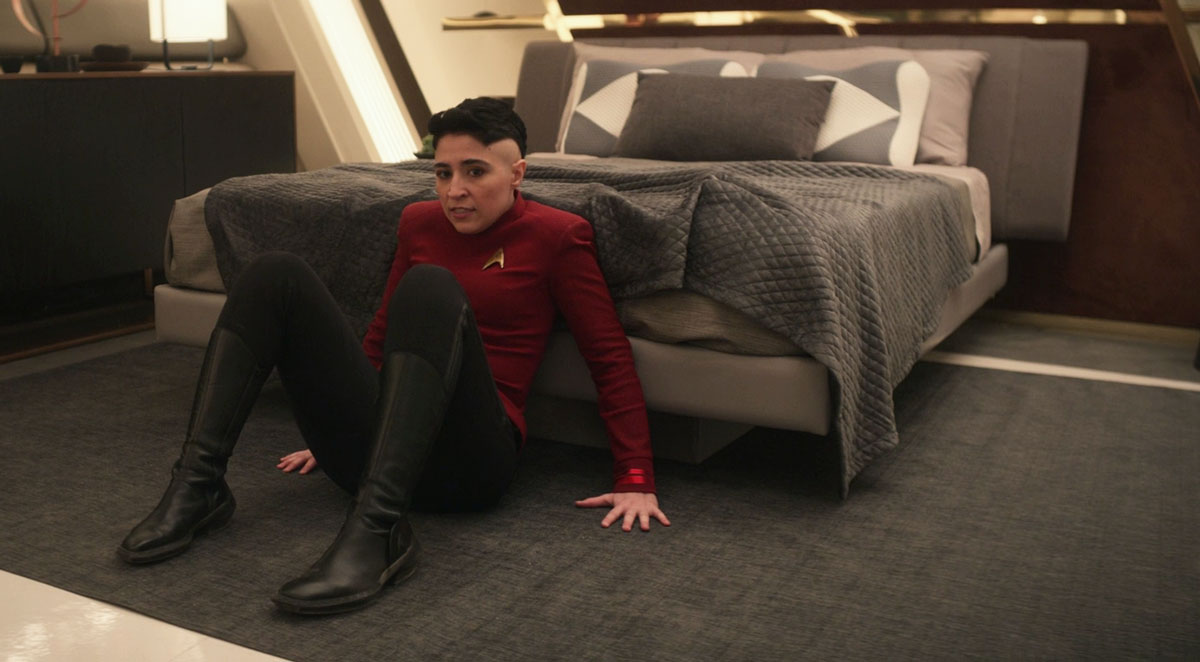
Things have gotten worse on the Enterprise; Spock and Ortegas have forgotten who they are completely, and Ortegas freaks out enough that she runs from the bridge, through a completely mind-wiped crew and back to her cabin. Cowering on the bed, she argues with the ship’s computer about who can save the Enterprise, only to learn that it’s up to her to rescue everyone.
She’s the pilot: she flies the ship! Apparently that’s so important to Ortegas that she can never really forget it, which is great – especially for the rest of the crew — as she returns to the bridge in triumph to dramatically fly the ship out of danger.
Planetside, M’Benga and Pike attack the palace, breaking past warriors and mind-wiped alike to get into the main chamber. Pike bars the door and overpowers Zach, demanding access to the memory casket. Zach only laughs, explaining that the whole thing is a myth: in reality, it’s the ore used in the palace walls and the guards’ helmets that protect their memories. Just by entering the palace, Pike’s will return… but not in time to save La’an.
Pike doesn’t believe him, as the captain beats and nearly shoots Zack in anger before his memory returns just in time, realizing what lengths his protectiveness for his crew push him to. “Rigel VII doesn’t change you,” says Pike, “it just shows you who you really are.”
(Apparently, for Zach, that’s a slightly mad despot who hasn’t changed his shirt in six years. Ew.)
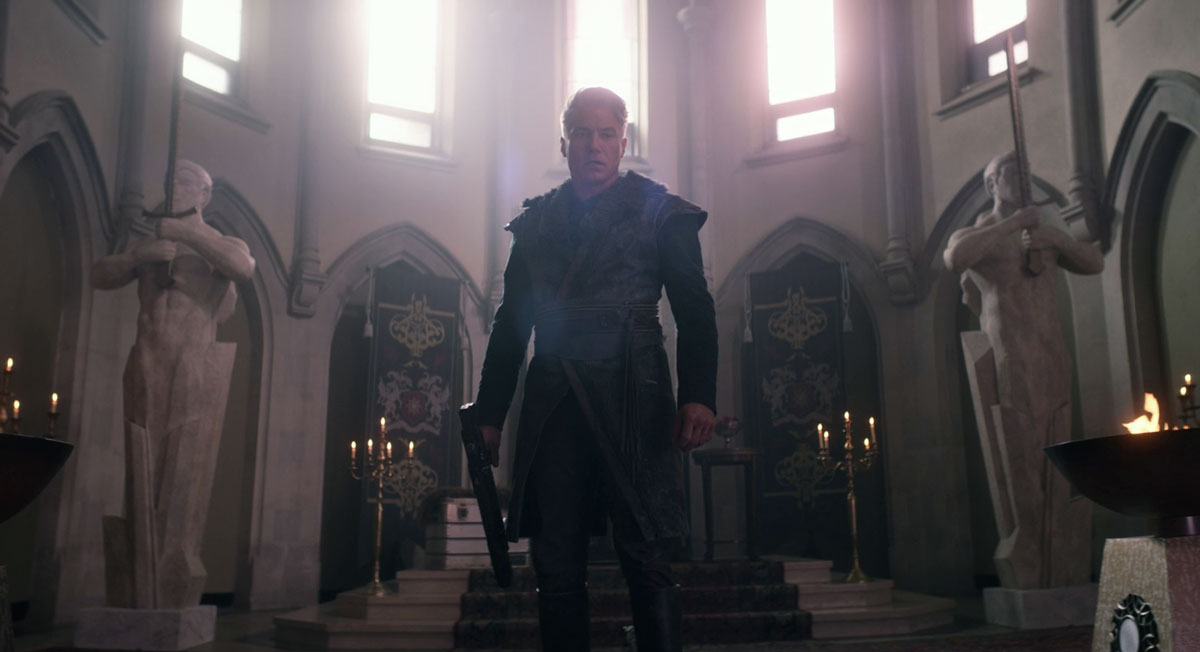
Pike, seemingly horrified at what he was about to do, promises that Zach will be punished for what he’s done — but not until they save La’an, an easy task when Pike finds the cache of Starfleet equipment in Zach’s throne room. Luq also gains his memories back in a bittersweet moment of remembrance, as he weeps in memory of his wife and son. Remembering people is better than shoving it down and ignoring it, folks. You heard it here first!
All is restored on the Enterprise too, thanks to Ortegas’ flying and an alteration of shield harmonics. She saved the day, but it would have been nice if she had gotten some more character depth in the process.
Pike also reconciles with Batel; the experience of losing and re-gaining his memory has made it very clear that no matter what, their relationship is too important to be discounted. It’s a nice roundup to the episode: Pike’s arc from Season 1 — overcoming the shadow of his dark future — has been closed, and now his interpersonal relationships have value beyond the temporary. It’s a well-rounded character arc for the episode, and a nice way to push Pike and Batel’s relationship forward.
CAMP NONSENSE OF THE WEEK
This week’s camp nonsense award (sadly missed, I’m sure, from last week’s review) goes to Ortegas in the native hat she wears in preparation for landing party duty. It’s a good hat, Erica, I promise. No idea what the others are on about.
OBSERVATION LOUNGE
- The Starfleet delta seen on the surface of Rigel VII is based upon the design introduced in Star Trek: Discovery, apt for a planetary visit from six years prior to the episode.
- Mentions of Spock’s injuries is consistent with “The Cage,” where the Vulcan sports bandages and a limp from the Enterprise’s first visit to Rigel VII.
- The mentions of Spock’s injuries are another nod to the script and background of The Cage – Spock, in fact, still has a limp and some dressings on him during the Cage itself!
- Batel found the Opelian mariner’s medal on the farming colony of Gault, where Worf grew up after his adoptive parents rescued him from the Khitomer attack.
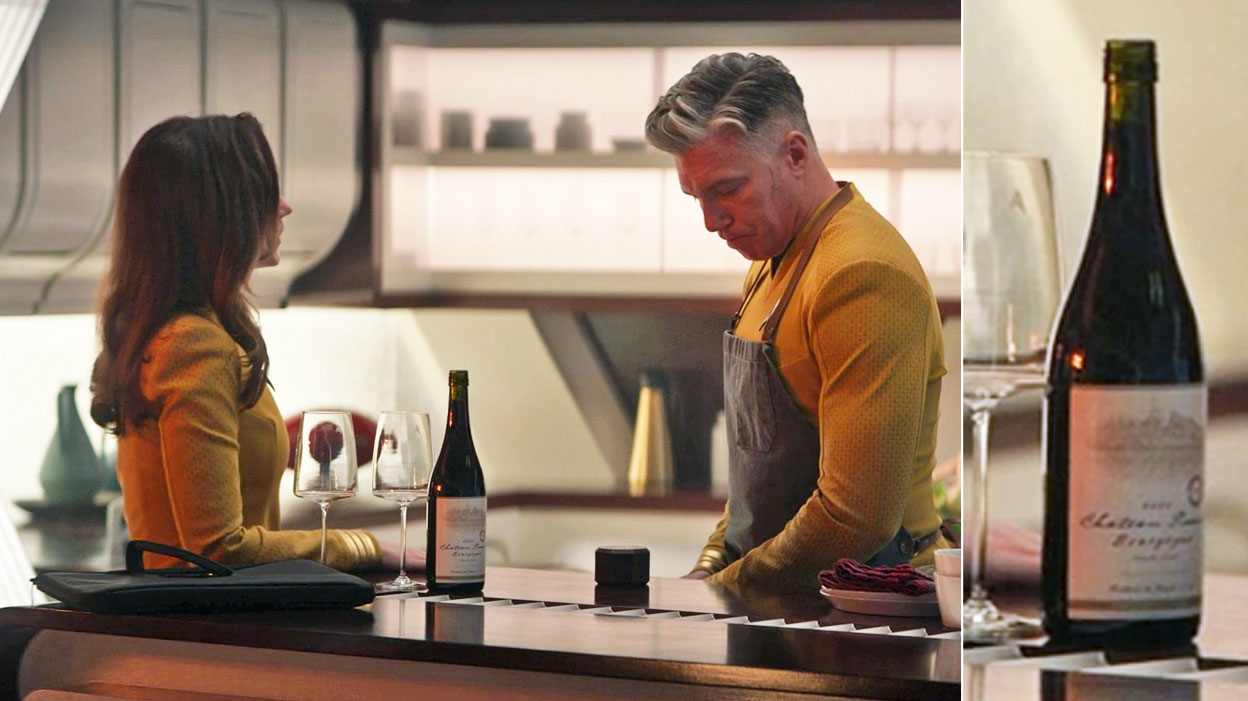
- Pike and Batel share a bottle of Chateau Picard (vintage 2221); a version of the same bottle was released last year through Star Trek Wines.
“Among the Lotus Eaters” has some interesting ideas, and the concept of a caste society built around memory is unique and intriguing. It’s well acted, certainly, and Mount makes the most of his first big episode of the season, but the plot is somewhat lacking. Following up on the Rigel VII incident — the inciting prelude to “The Cage” — is absolutely the perfect thing for Strange New Worlds to do, but it just felt undercooked.
I’d have liked more focus on the people Pike left behind — especially Zach — and what that meant, over the whole “memory loss-regain” thing that, while intriguing, was still very stretched out. I think the focus on what is important to Pike (his love for his crew, and for Batel) is a great piece of closed storytelling, but I think I would have liked a bit more sophistication from a ten-episodes-per-season show.
The visuals were also dampened by prodigious usage of the AR wall soundstage, which certainly gave the whole thing an claustrophobic Original Series-esque “planet of the week soundstage”, something that I thought we’d left behind.
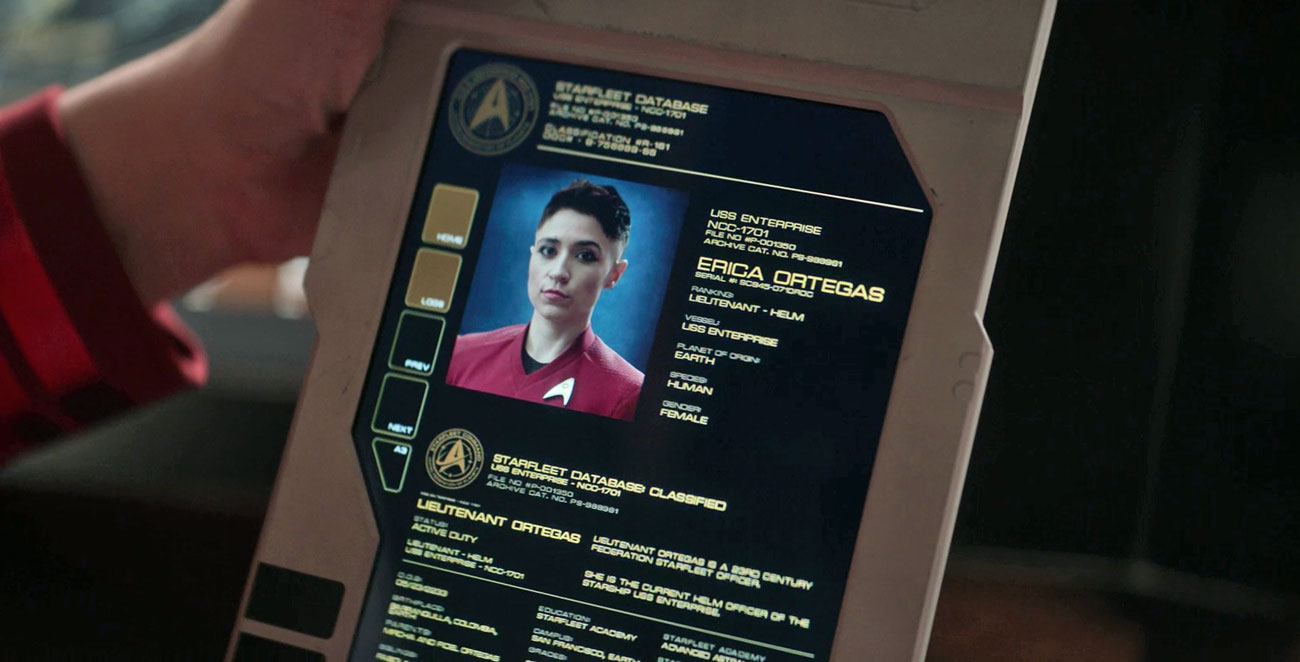
I think my biggest criticism, however, is the handling of Erica Ortegas’ character, one for whom fans have been clamoring for focus since the series debuted last summer. Last season, we got virtually zero development for the Enterprise pilot, and nearly halfway through Season 2, we’re up to… “I fly the ship.” Remembering how exciting and important your passions are can be is good, but this is not character depth; this is a job description.
This isn’t like the Star Trek: Discovery bridge crew, where the four or five extra bodies on that set occasionally get some lines or small spotlight moments; Melissa Navia’s part of the credited main cast and she plays Ortegas brilliantly — but there’s almost no depth to work with, something that annoys me greatly.
We learnet more about Sulu in the first aired episode of TOS than we have about Ortegas in the last fourteen episodes, and that is increasingly irritating, especially if this was the expected Season 2 “Ortegas episode” viewers had been hoping for.
Hopefully it won’t take until Season 3 for fans to spend some more personal time with her.
Star Trek: Strange New Worlds returns with “Charades” on Thursday, July 13 on Paramount+ in the U.S, the U.K., Australia, Latin America, Brazil, France, Italy, Germany, Switzerland and Austria.
Thursday, 29 June 2023
STAR TREK: STRANGE NEW WORLDS Review — "Tomorrow and Tomorrow and Tomorrow"
STAR TREK: STRANGE NEW WORLDS Review — "Tomorrow and Tomorrow and Tomorrow" • TrekCore.com
blog.trekcore.com
“Tomorrow and Tomorrow and Tomorrow” is time travel episode that lasts for 61 minutes. It’s a reasonably interesting plot with a decent payoff… that lasts for 61 minutes. It’s got some great character work from Christina Chong and Paul Wesley that indulges in their excellent chemistry… but it lasts for 61 minutes. (I think you’re getting the point now).
The time travel shenaniganry, while fun, relies to heavily on a mystery box that lasts for 45 minutes or more; and a twist that really should have come a lot earlier in the plot.
We open with La’an Noonien-Singh’s (Christina Chong) routine as security officer seeming to drag. Interpersonal disputes, noise complaints and Pelia’s (Carol Kane) light-fingered kleptomania are all beginning to grate on the security chief, who — despite the best suggestions of Dr. M’Benga (Babs Olusonmokun) seems determined to do it all alone. The (self-induced) beatings will continue until morale improves, it seems… until a stranger materializes on the Enterprise. Foisting a futuristic device into La’ans hand, the grey-suited man (Christopher Wyllie) tells her of an attack in the past, and that she must “get to bridge!” before dying a gunshot wound.
La’an makes her way to the ship’s command center quickly, only to find a crew that doesn’t recognize her, and Captain James T. Kirk (Paul Wesley) in command.
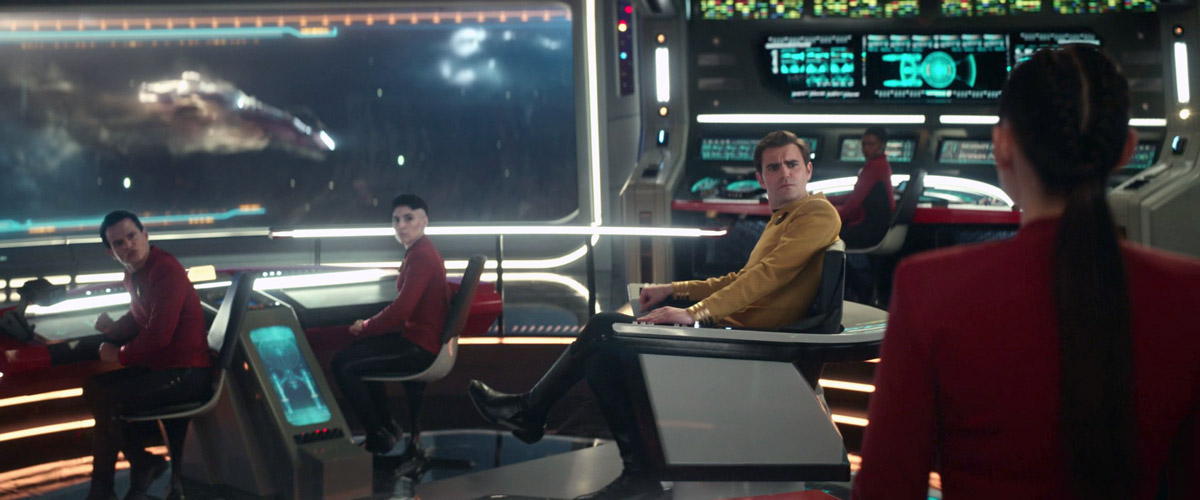
Captain Kirk of the United Earth vessel Enterprise grapples with this new interloper has he turns down a request for aid from Captain Spock (Ethan Peck) of the Vulcan ship Sh’Rel — but it’s La’an, with her strange badge and stories of an alternate reality that command his focus and disbelief. La’an is convinced that she –- and Kirk — must go back in time to fix history. Kirk isn’t convinced, however, and wants to inspect the grey-suited man’s device, which is the last thing La’an wants.
A brief “struggle” results in them both being tossed back into the past without any preparation: no phasers, no communicators and no tricorders. Despite Kirk’s frustration with this predicament, he agrees to help, and together they explore 21st century earth; no, not New York City, but Toronto (home, of course, to Star Trek: Strange New Worlds and Star Trek: Discovery production).
Through theft from a Roots store, chess hustling and the purchase of some hot dogs at the Toronto Harbourfront, we learn more about Kirk and his reality — where Earth is a battle-scarred wasteland and humanity lives scattered amongst the solar system; no Iowa, no sunsets and no Canada. Tragic, really. La’an begins to warm to him a little, and why wouldn’t you? Wesley’s Kirk oozes quiet, affable charm in half smiles and shrugs, while also still having that flair of bravado and intelligence that we have learned to expect from the inventor of fizzbin — or a premier 2D chess hustler.
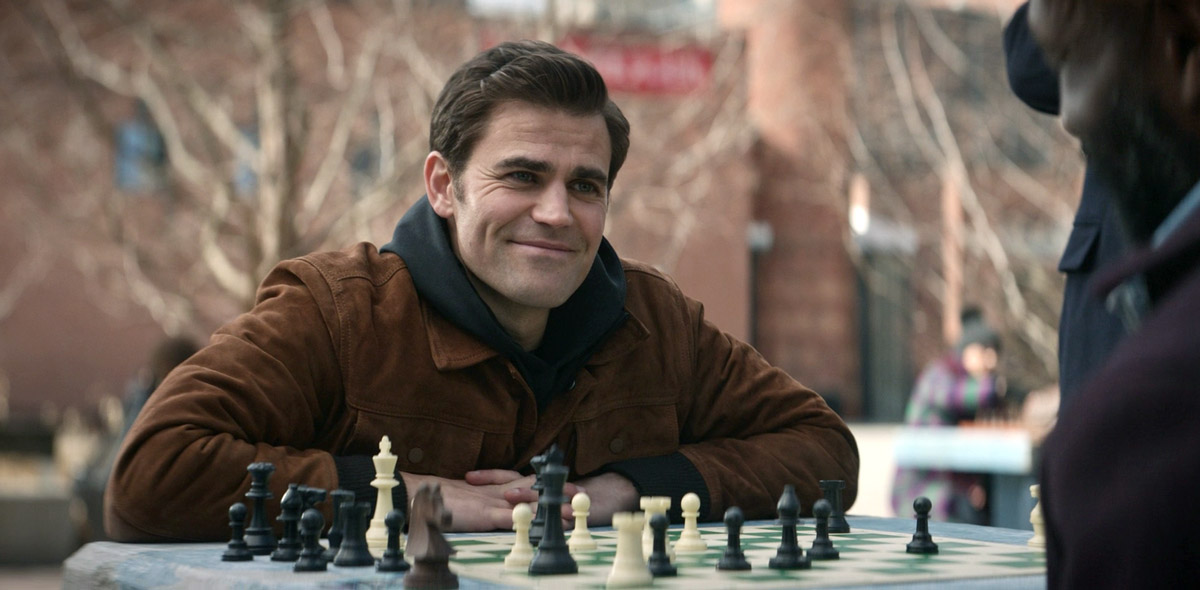
The sequences are nice, but as they drag onto into evening and morning — via a rather tortured “I can’t sleep, so I’ll watch the other person sleep” moment — the whole thing gets a little tired. We do, eventually, get to the crux point of their differences on “what is the correct timeline,” the classic time travel debate: one that makes clear how Alt-Kirk’s United Earth is merely surviving on the edges of the solar system, paling in comparison to the prime timeline’s paradise: where La’an’s version of Earth still has sunsets, and Kirk’s brother Sam is still alive.
This crucial point is interrupted by the dramatic (and far less interesting) explosion of the Lake Ontario bridge, which has collapsed in a massive explosion.
The duo race to scene, where they discover that the bridge was blown up with photonic weaponry (certainly not available in this time period) ; the evidence is carted off by a mysterious black van, which leads to a reasonably entertaining car chase through Toronto. Listen, I know we all love the whole “Jim Kirk can’t drive” thing, but the car chase just actually lasted too long, with two acts and a bad musical cover. The most interesting bit was the argument over Kirk’s middle name, which leads to the discovery that this Kirk does not recognize the name Noonien-Singh at all.
It’s a mysterious portent and a little titbit of something interesting within a few minutes of Dodge Challenger product placement.
Eventually, the police catch up with Kirk and start to arrest them; only for the photographer from earlier, Sarah (Adelaide Kane) to ward them off with a phone livestream and accusations of police harassment. This, erm, rather light touch nod to the current state of attitudes to the police (especially when compared with Picard Season 2) is only really here as a segue to introduce the woman, who has also been tracing the mysterious debris to its black-site home.
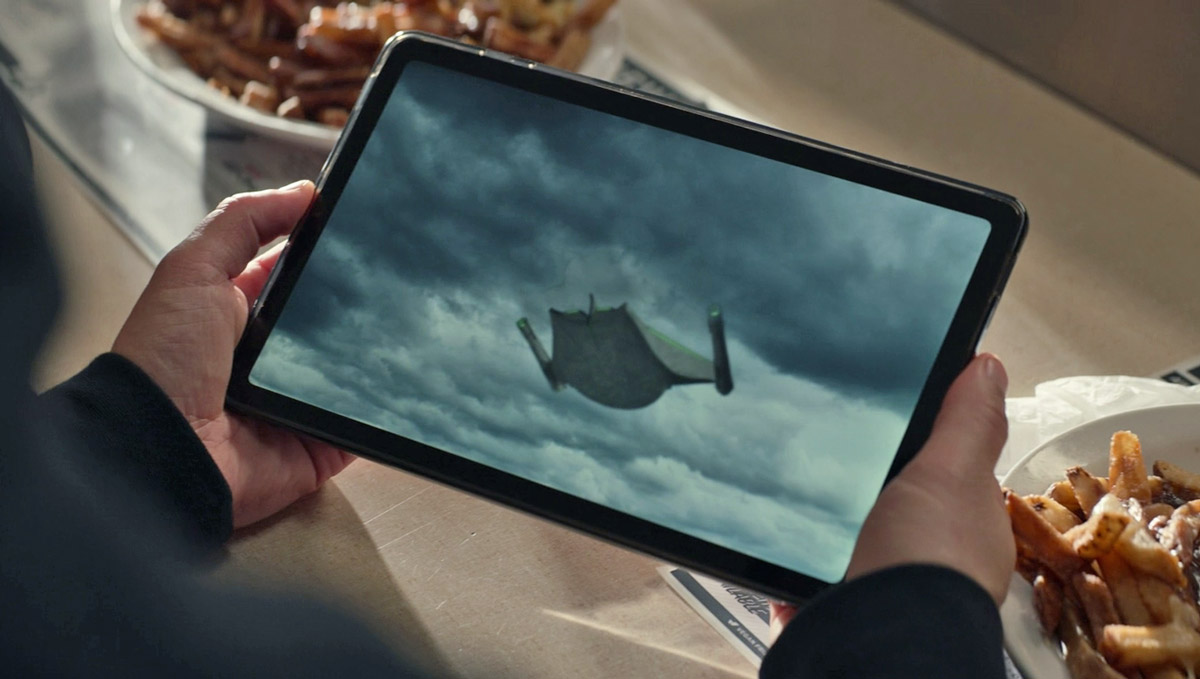
Then again, as we learn in a diner, Sarah isn’t a complete conspiracy nutjob, because she’s got photos of a Romulan warbird, and knows of a cold fusion reactor in Toronto that is probably at the same secret location. Only now does Kirk remember that this reactor is about to explode and destroy Toronto as part of a Romulan first strike: a detail that he (and the writers, honestly) should have informed of us earlier instead of making us do all that stuff with the bridge that is immediately forgotten.
Instead, we now get treated to the third side-quest of the episode, as La’an and Kirk go in search of someone who could discretely make them a device to find the reactor: none other than Pelia, who has holed herself up in a warehouse in Vermont during this point in history.
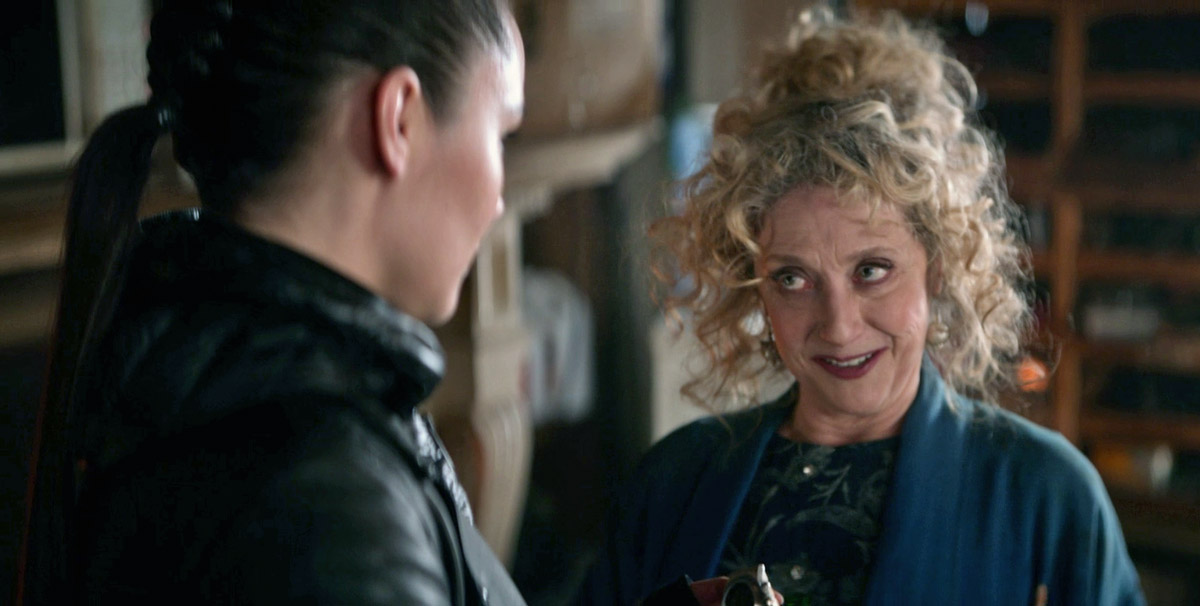
This is a cool connection, and reasonably well foreshadowed; but they could have done this a) earlier in the episode and b) with a bit of linkage into the general plot than yet another stage on the mystery box circle of doom. I like Carol Kane! I do! She’s great here, especially as she bumbles about trying to work out why they’ve come to her for engineering help when she isn’t an engineer (whoops).
But it’s really contrived; and we’re nearly 45 minutes into the episode and we’re still chasing…what? A cold fusion reactor that might explode? And we’ve only now found out it’s probably the Romulans? When we could have found that out about 20 minutes ago?
Even this sequence — where La’an devises a cold fusion reactor finding-device out of an old wristwatch — is really laboured. Everything just goes on about three of four minutes longer than it should, and the character interactions that are enjoyable are just surrounded by fluff. Even when they return to Toronto for a nighttime walk beside the wonderfully identifiable architecture of the Royal Ontario Museum, the semi-flirtatious banter between La’an and Kirk just goes on too long.
Sure, we get this moment of La’an letting her defenses down up, and explaining why she feels the need to be so guarded, but I was watching it and wondering how exactly there was still 20 minutes to go.
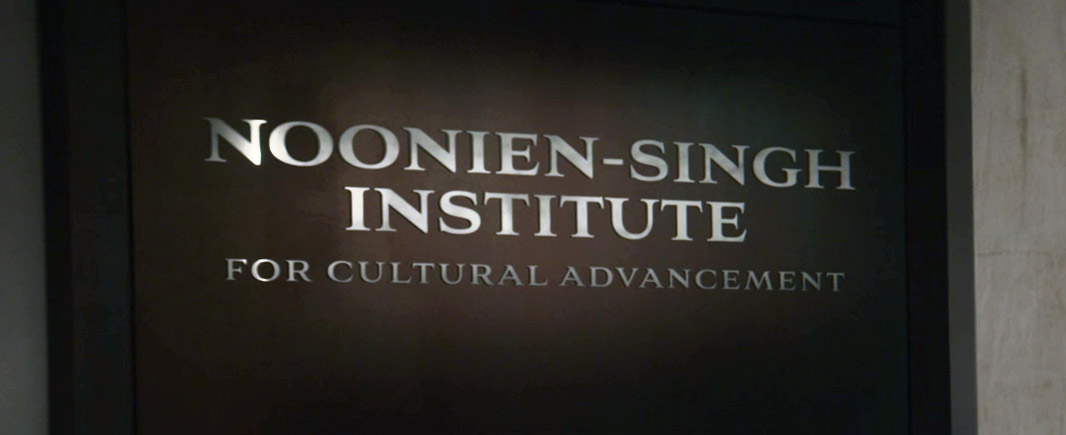
They also, of course, find the cold fusion reactor, which is inside of the “Noonien-Singh Institute” — I guess the ROM is renting to eugenicists now? — which is great – until Sarah shows up with a gun, revealing that she is also a time traveler… and a Romulan agent. She’s come back to alter the future and prevent the Federation from existing, which seems to happen a lot to the old UFP, doesn’t it? In typical Kirk fashion, Jim believes that she’s bluffing, and attempts to talk her down.
Until she kills him, which is a nice way to undercut the character trope. Good thing this isn’t our Jim Kirk, eh? La’an gets little time to mourn -– I say little, but the moment drags on long enough to kind of kill the tension –- before Sarah drags her into the black site, killing anyone in their way before reaching her target: the locked quarters of a young Khan Noonien-Singh. Yes, that’s right folks, it’s “kill baby Hitler” time. Hooray.
Sarah begins monologuing, and explains her whole rationale to La’an. The Romulans have a “time altering assessment computer” (presumably it came free with the cloaking device) that they use to assess nudges in history, and getting rid of Khan is a surefire way to stop the Federation forming. Sarah also shares her frustrations with the whole plan, and the increasing complications that the Temporal wars are causing as they shift the timeline, and time “pushes back”. Apparently, this was all meant to happen back in 1992.
Good news for Bill Clinton, I suppose, but bad news for this Romulan agent, who has been stuck on earth waiting for 30 years. But now, she’s going kill pre-pubescent Khan, and she’s doing her best to convince La’an to help. They’re both aware of the horrors Khan will inflict on earth, and that La’an knows she must let it happen.
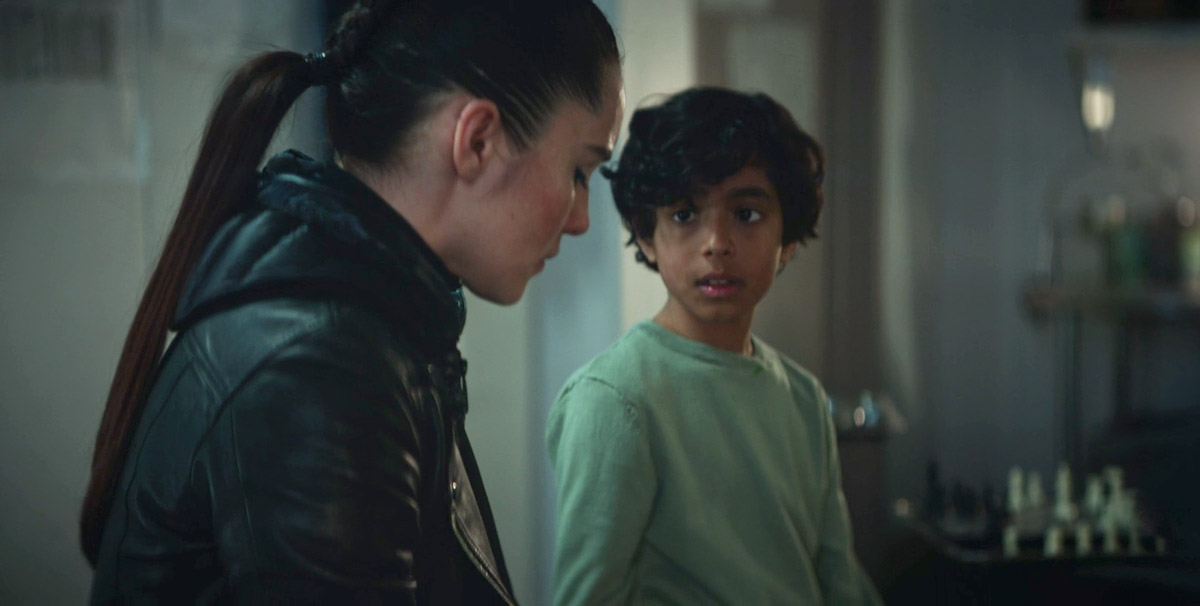
After stopping Sarah, La’an comes face to face with her young ancestor, Khan Noonien-Singh (Desmon Sivan). Making the descendent of a mass murder meet their hated ancestor and then having her tell him “He’s in the right place” is mental. It feels abhorrent to say and accept that La’an just must let him live, but’s that the “kill baby Hitler” philosophical debate all over. The “right” course of history must be protected, which despite everything is kind of the point.
Returning to the Enterprise, La’an finds that all is well and back to normal… only to find to find Department of Temporal Investigations agent Ymalay (Allison Wilson-Forbes) waiting for her.
La’an does confront Ymalay with the correct view on it, which is that they — whether they intended to or not — made her make a horrifying choice to protect the timeline. Ymalay does sympathize, but only a little. This whole incident was a mistake on their part, and one that La’an fixed. Which, of course, means she never gets to talk about it again. Go time travel! With time restored and the 29th century device returned, La’an calls up the correct-timeline Lieutenant Jim Kirk — just to see that he is alive and well, before collapsing with emotion.
KIRK ALERT
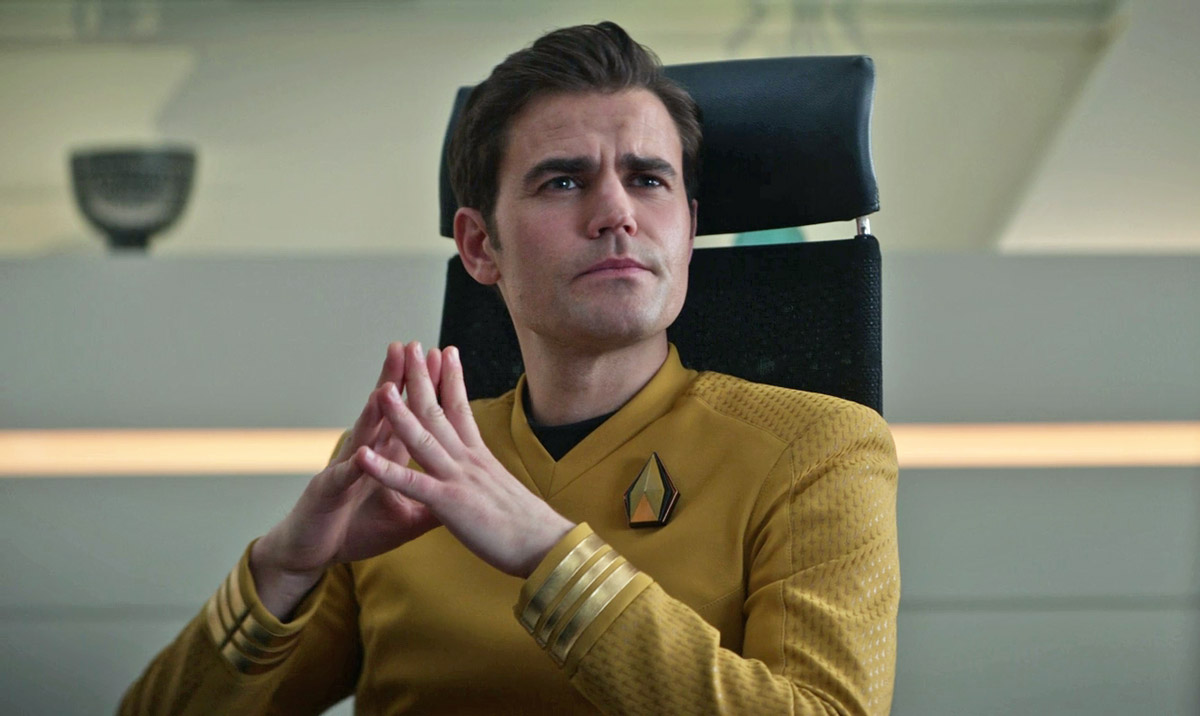
So, Paul Wesley’s back for round two as James T. Kirk: how did he do? I think he did very well here. With a lot more screentime than in “A Quality of Mercy” — and some good story beats to bounce off of — Wesley is clearly coming into his own as the inheritor of one of science fiction’s greatest characters. This Kirk increasingly feels like his character, and not a pale imitation of either William Shatner or Chris Pine, but there are still instinctive actions, phrases and expressions that make this indisputably Jim Kirk.
The confusions around the revolving door, the attempted bluff with Sarah, the unique and Shanterian delivery of “My God…” when the bridge explodes — it’s all James T. Kirk. I’m looking forward to more of it, but next time, will the “real” James T. Kirk please stand up?
OBSERVATION LOUNGE
- The grey-suited man’s time travel device utilizes the same TCARS interface system seen aboard 29th century Wells-class Starfleet vessels. This computer system was introduced in the 1999 Voyager episode “Relativity,” and was revived by Strange New Worlds graphic designer Timothy Peel.
- This episode marks the first appearance of agents of the Department of Temporal Investigations since its origination in 1996’s “Trials and Tribble-ations.” (The agency did, however, have its own series of tie-in novels chronicling the adventures of Agents Dulmer and Lucsly.)
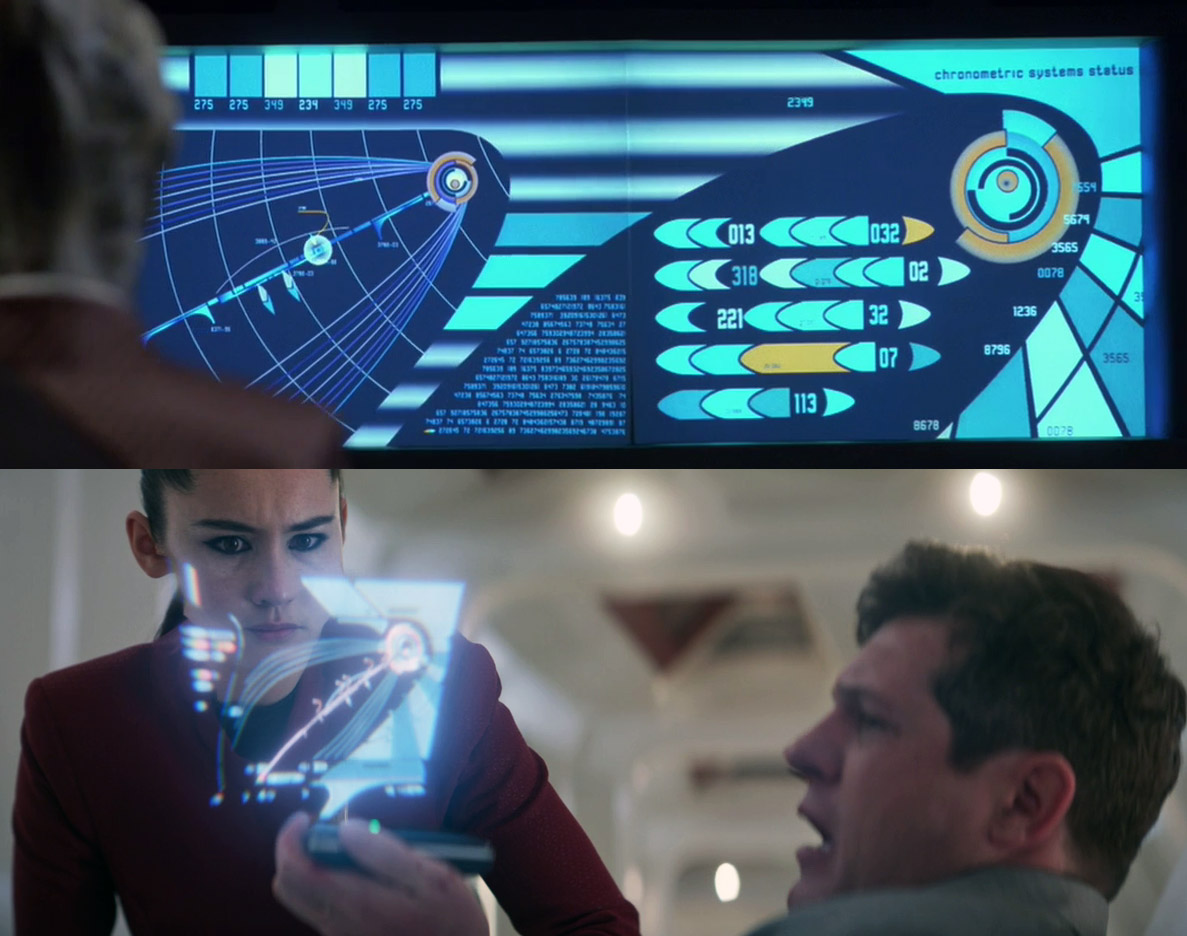
- La’an calls Toronto “The biggest city in what used to be called Canada,” indicating that the country’s name (or its existence as a regional identity) has changed since the 21st century era.
- La’an breaks up a dispute between Transporter Chief Jay (Noah Lamanna) and a Denobulan cadet in the start of the episode; while they’ve been seen in animated form in Lower Decks and Prodigy, this is the first live-action Denobulan seen since Dr. Phlox in Star Trek: Enterprise.
- Kirk refers to his grandfather Tiberius as the source of his middle name; this piece of Kirk family history was established in the opening moments of the 2009 Kelvin Timeline Star Trek film.
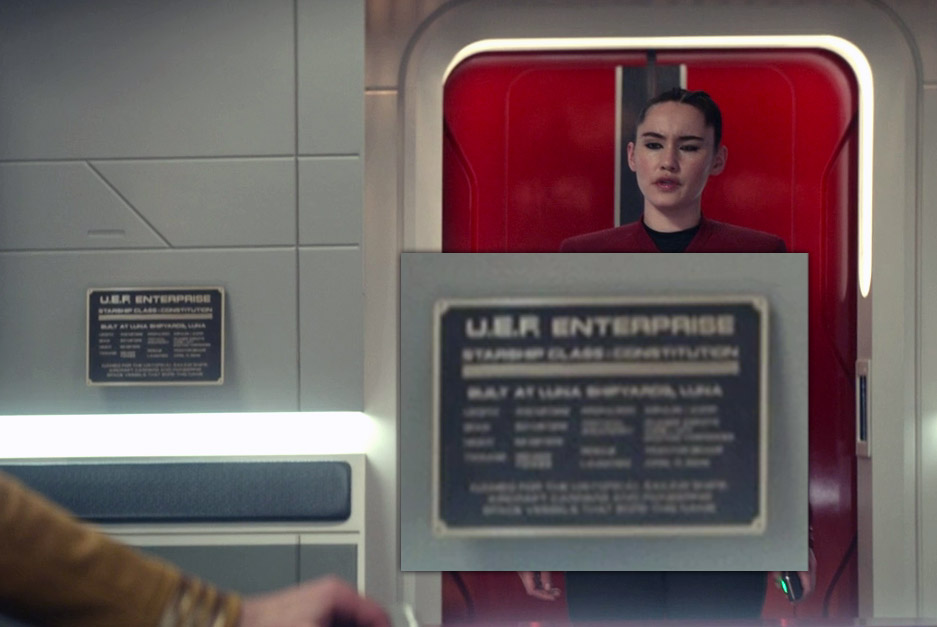
- According to its alternate-reality dedication plaque, the United Earth Fleet UEF Enterprise was build at the Luna Shipyards — since there’s no San Francisco left in this dark 23rd century.
- Somehow, La’an’s handprint was able to unlock the secure area of the Noonien-Singh Institute. If that was possible due to her Khan-sourced DNA, how likely is it that the Institute would let one their lab-created children have access to the site’s security system?
- The Torontonians amongst the viewers will no doubt have enjoyed the various on-location shots at Yonge-Dundas square, the Harbourfront and the Royal Ontario Museum, which were fun moments for those of us familiar with the city. The joke about Kirk thinking they were in New York is also a delightful nod to the Canadian city’s role as a stand-in for the Big Apple in a great deal of television and film.
“Tomorrow and Tomorrow and Tomorrow” is a good concept for a time travel episode, but the execution was just a bit flat. This is no “Yesterday’s Enterprise.” It’s certainly no “City on the Edge of Forever.” It’s got a lot more in common with Enterprise’s “Carpenter Street” in many ways. Chong and Wesley are really good actors, and I can see why they were paired together; the chemistry is good, but it’s not really romantic chemistry in my view.
There’s a certain veneer of a fan-fiction pairing to them that I think should’ve stayed on the cutting room floor, and the fact that the romantic tension is very limited before they kiss speaks to that. This is a standout episode for Christina Chong, and though she’s excelled for every moment she’s had in Strange New Worlds, and she once again proves that she is one of the best parts of this show.
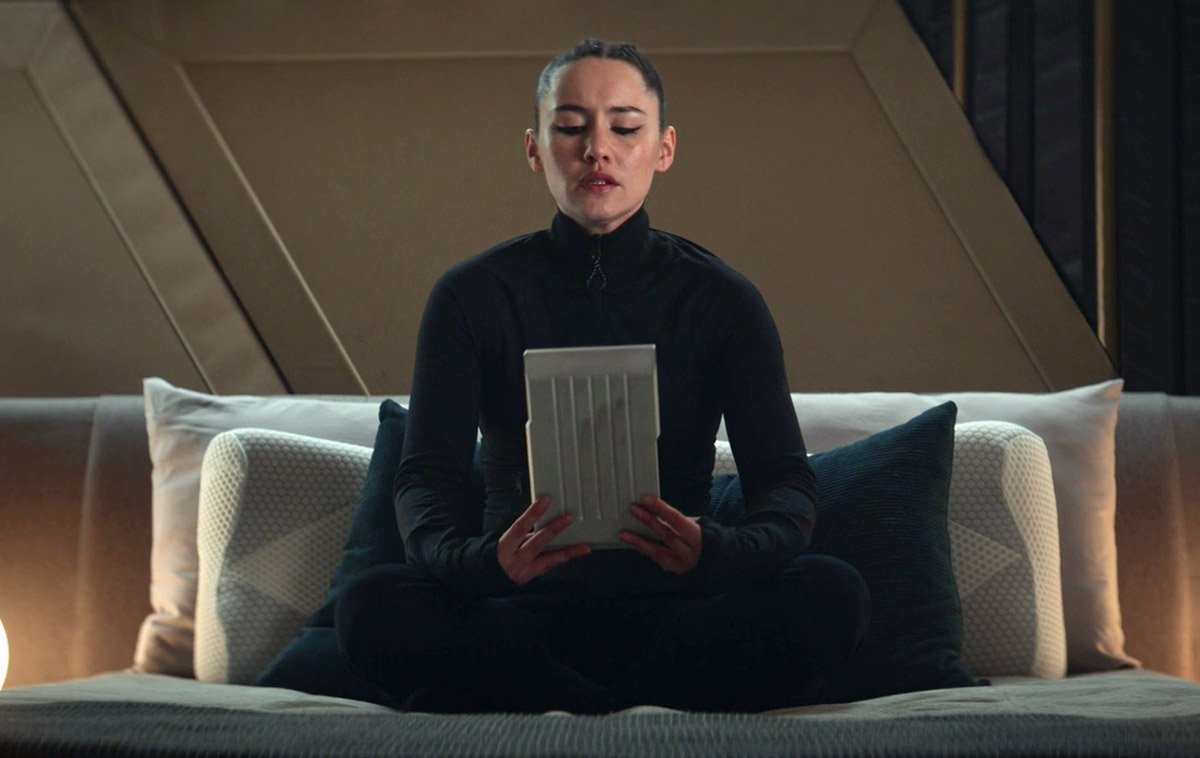
Overtly tying the Temporal Cold War of Enterprise back into canon as an explainer for differences in timeline — after learning about the War’s future impact to the Discovery era — was clever, but that was kind of it for plot moments I enjoyed.
Still, it was a good advert for the Ontario Tourist Board, so give them that. I would recommend visiting Toronto in the summertime, however: it’s warmer, and there are significantly fewer time travelling Romulans to worry about.
Star Trek: Strange New Worlds returns with “Among the Lotus Eaters” on Thursday, July 6 on Paramount+ in the U.S, the U.K., Australia, Latin America, Brazil, France, Italy, Germany, Switzerland and Austria.
Tuesday, 27 June 2023
STAR TREK: DISCOVERY Book Review — "Somewhere To Belong"
STAR TREK: DISCOVERY Book Review — "Somewhere To Belong" • TrekCore.com
blog.trekcore.com

The second and apparently final Star Trek novel of 2023 is Dayton Ward’s latest, Star Trek Discovery — Somewhere To Belong. Set in the months between the show’s third and fourth seasons, Ward’s newest Star Trek novel is a highly enjoyable trip down memory lane for the Discovery crew that makes good use of both Discovery’s original 23rd century setting, and its adopted 32nd century galaxy of the future.
The remainder of this review contains light spoilers for the plot of “Somewhere To Belong.”
Somewhere To Belong fills in a few of the gaps following Season 3’s story, after the Discovery crew solves the mystery of The Burn and the Federation begins to reestablish contact with many of its former members — but before the emergence of the DMA that kicked off the events of season four. We find the Discovery carrying out the mission it was tasked in the final seconds of Season 3, leading the Federation’s efforts to get reacquainted with the rest of the galaxy.
Tie-in novels to television shows that are largely serialized can be hugely beneficial for establishing character or exploring themes or ideas from the show that the show itself did not have time for in servicing its larger plot lines. And Somewhere To Belong serves that role well, providing for a much deeper examination for the whole crew of the implications of their millennia hopping time travel than we were able to see during the show itself.
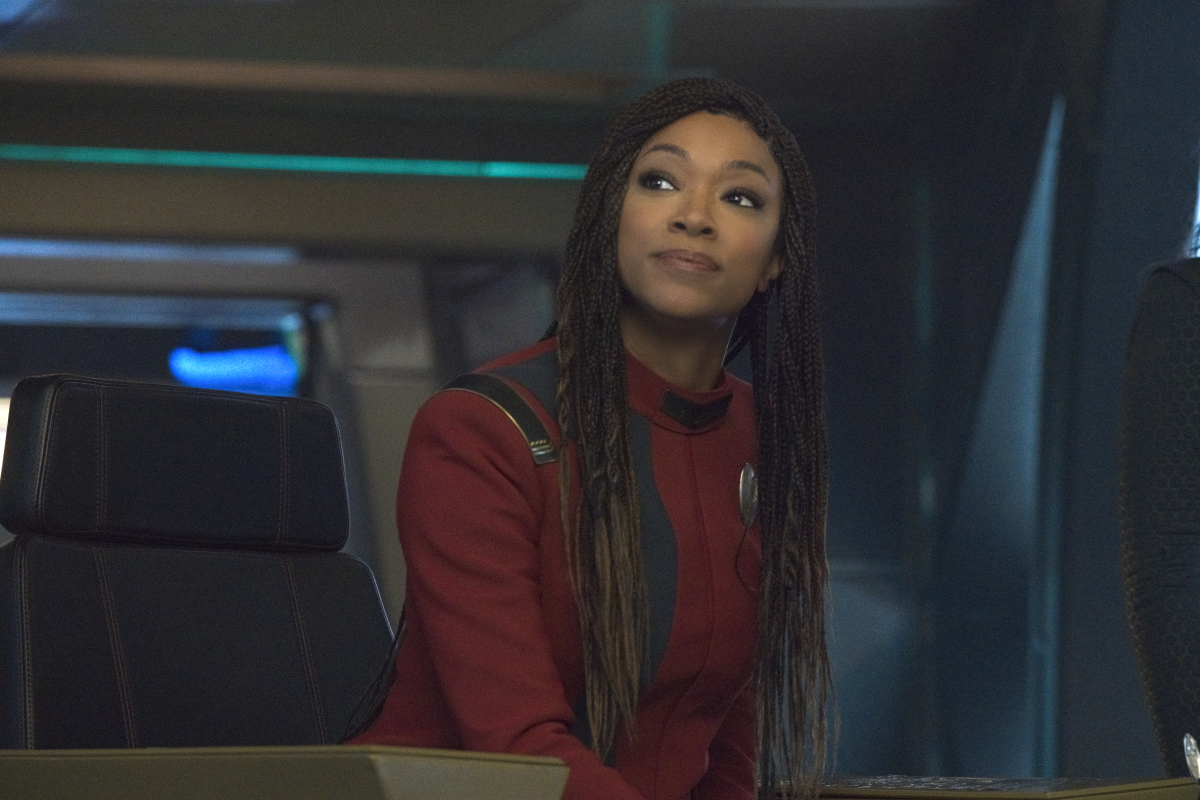
The book does an excellent job of revisiting Discovery’s own history and taking maximum advantage of the show’s unique presence in two completely different parts of Star Trek history. As the ship and crew continue to orient themselves to the 32nd century, they encounter a race they have important history with.
That race is the Xaheans — who first appeared in the “Runaway” Short Trek, with their return in “Such Sweet Sorrow” season-ender. In those episodes, Sylvia Tilly formed a close bond with Po, a Xahean destined for the throne of her world, a planet that was rich in dilithium — a mineral that the Xahean people had a special bond with.
Now in the 32nd century, Discovery again encounters the Xahean people, finding that time has not been good to them. Ward tells us the history of the Xaheans after Discovery left the 23rd century, and many of the events of subsequent years that we know about from other Star Trek shows swept in the race and have left them in a dire place.
Somewhere To Belong is a story about grief, loss, and regret. And yet despite those themes, it’s actually not that much of a downer, and serves as a hopeful tale about how even the most challenging circumstances can result in hope and progress. The novel does not shy away from some of the hardships that many in the galaxy have faced in the years that Discovery was a way, but also shows that the sins of the past can be addressed if they are properly acknowledged.
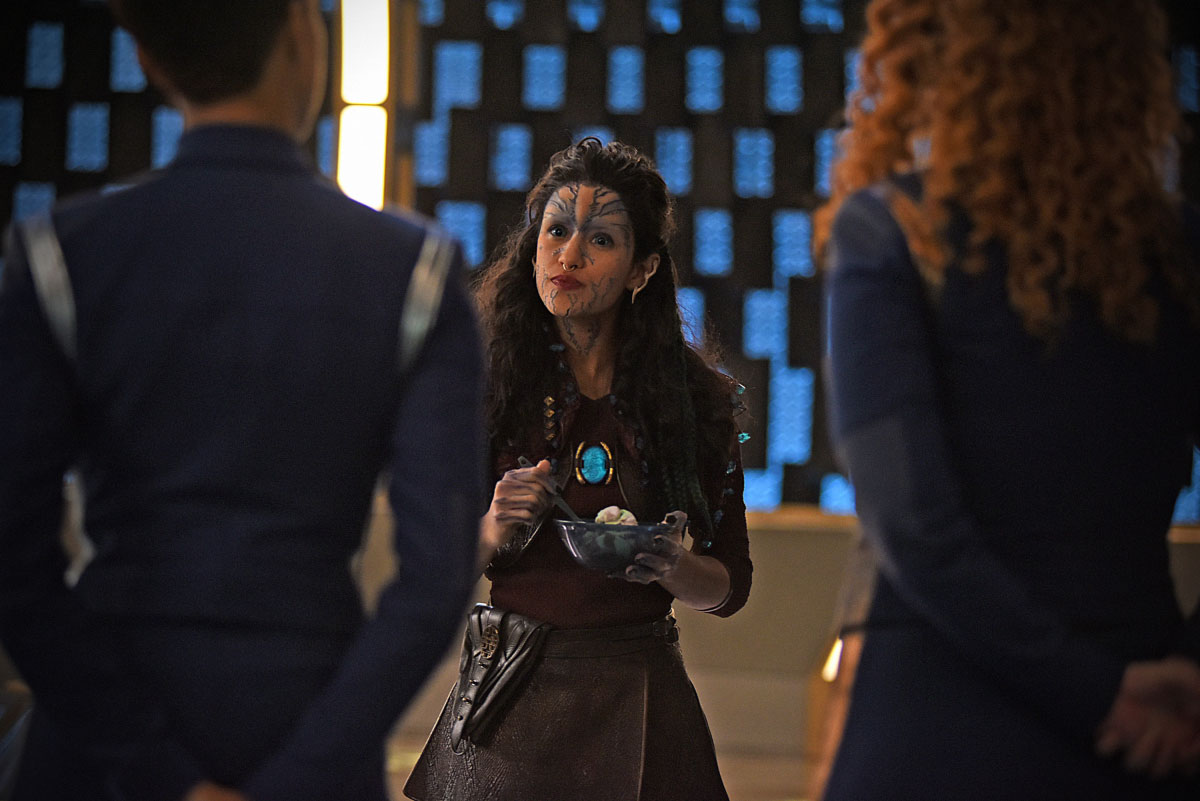
Using the Xaheans allows for Ward’s story to draw from the show’s history both before and after time travel, and serves as a good accompanying narrative for sections of the book that give characters a chance to breathe and reflect upon the big changes to their lives brought on by the time jump to the future and the rollercoaster of events that followed. The book uses Hugh Culber as a through line character for that examination, in a way that mirrors the show’s own use of Culber in Seasons 3 and 4.
Somewhere To Belong also allows some space for a few leftover story threads from season three to be addressed that were not really examined in Season 4; namely the animosity that was created between Paul Stamets and Captain Michael Burnham in the wake of “That Hope Is You, Part 2.” Ward provides some story space to address this, and why it all seems to be water under the bridge by the beginning of Season 4.
Ward also does a really nice job of world building — not just for the Xaheans, who get a deeper examination than they did in season of Discovery, but also in terms of continuing to build out the 32nd century. The book is careful not to stray too far outside the lines of what Discovery has already established, given the possibility the show might contradict later details with its upcoming fifth and final season, but Ward does a nice job of connecting the 32nd century with earlier eras of Star Trek.
It helps make this era feel more connected to the wider Star Trek universe than the show has managed to date, and is a credit to Ward’s writing.
Overall, Somewhere To Belong is an enjoyable read, that lives nicely within the Discovery style and explores more of some of the show’s themes and stories in a way that feels additive to your enjoyment of the show as a whole.
* * *
While there’s another Star Trek: Prodigy young-reader tale coming in August — Cassandra Rose Clarke’s Escape Route — it’s just a shame that we’ll have to wait another nine months for the next mainline Star Trek novel: David Mack’s Star Trek: Picard — Firewall, telling the story of Seven of Nine’s journey from the USS Voyager to the Fenris Rangers.
Hopefully there will be more than just two or three entries into the literary Star Trek library in 2024.
Star Trek: Discovery — Somewhere To Belong is in stores now.
Thursday, 22 June 2023
STAR TREK: STRANGE NEW WORLDS Review “Ad Astra per Aspera”
STAR TREK: STRANGE NEW WORLDS Review — “Ad Astra per Aspera”
“Ad Astra per Aspera” is more than just a classic courtroom episode: it is arguably the strongest attack Star Trek has made on the social questions and reactionary politics of our time, in a tradition that goes right back to the days when Gene Roddenberry fought with CBS executives over interracial kisses and women in authority positions. It is enjoyable, it is direct, and it is bold. It falls short in some ways with the use of allegory, but it’s message of defiance and hope is unavoidable.
We open with a flashback to Una’s fearful childhood; a slightly dissonant beginning that does highlight the dangers of being an augment in Federation society. In the present, Lt. Commander Una Chin-Riley (Rebecca Romijn) is offered a plea deal by Captain Batel (Melanie Scrofano), who has for reasons best left to the writers been enlisted as the prosecution in Starfleet v. Chin-Riley.
The offer, which would result in a dishonorable discharge for Una, reeks of a grim coverup, and of Starfleet not willing to confront the fact that it let an augment this far into it’s ranks. With only a half-hearted defense lawyer from the JAG office to defend Una, Captain Pike (Anson Mount) has gone to the Voltara Nebula in search of Neera(Yetide Badaki) — an Illyrian lawyer and former friend of Number One — to take the case.
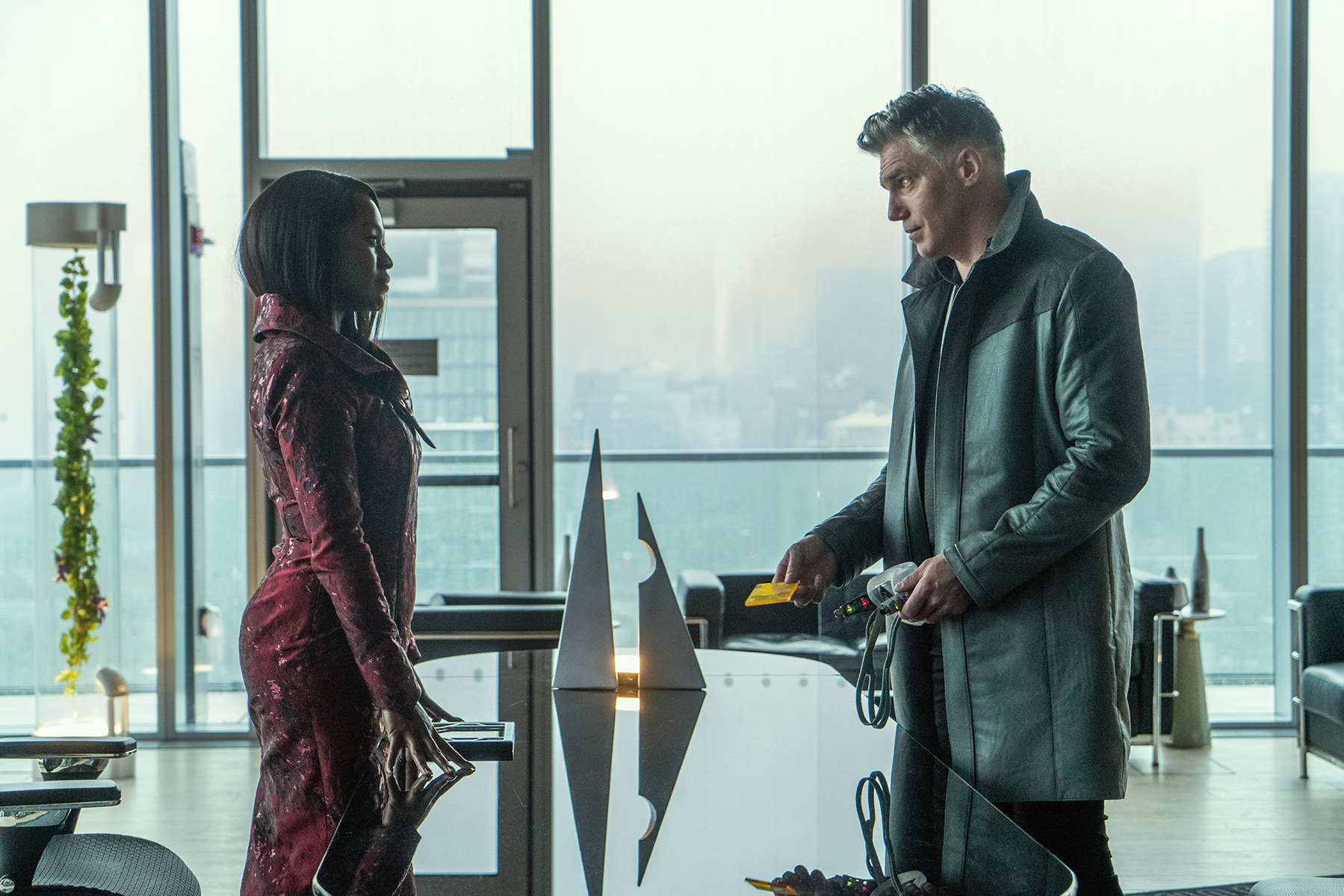
After getting into her office on pain of asphyxiation in the toxic atmosphere of the planet, Pike pleads Una’s case to the deeply disinterested Neera. Her hostility to the UFP and it’s anti-augmentation laws is clear, and even Pike’s admittance of his own faults and disapproval of Federation policy does little to sway her; the draconian race laws of Starfleet would seem to give Una little chance of success. Pike does point out that Neera’s own civil rights struggles against the Federation are hitting dead ends, however: defending Una and winning would give her the platform and profile to make serious inroads against anti-Augment laws.
It’s an opportunity she can’t seem to refuse as she turns up to defend Una, giving her old friend the coldest of cold lawyerly shoulders as she prepares to take up her defense. These sequences, even as the barest table settings, make clear that this is going to be a lot more than a rehash of Next Gen‘s “A Measure of a Man,” and miles away from the (frankly) half-assed civil rights discussions of Voyager‘s “Author, Author.”
There isn’t going to be any view from both sides of the coin: the episode knows what’s right and what’s wrong, and the narrative makes sure you do too.
Neera is defiant and eloquent even here as she attempts to turn down Pike’s plea, and even when she arrives on Earth; her conversation with Una immediately dives into the nuances of marginalization and bitterness between those who can pass and those who cannot. Una doesn’t want to hide anymore; but Neera correctly points out that many others can’t hide, and others — like her — won’t.
Nevertheless, the plea deal is turned down, much to Batel’s fury; her offer cost her a lot to get and now JAG prosecutor Admiral Pasik (Graeme Somerville) is pushing for a harsher sentence: discharge, a sedition charge and 20 years in prison!
With the stakes set high, both Una and Pike to their best to fight the case from the stand; both are argued down by Neera and Batel respectively on the point that the could jeopardize the careers of the whole Enterprise crew, who arguably have been covering up for Una the whole time. With the senior staff forced to watch from the sidelines, La’an Noonien-Singh (Christina Chong) does her best to find out whoturned Number One in, encountering resistance from Uhura (Celia Rose Gooding), who refuses to break regulations and give the security chief the private logs she wants. It’s a small moment, but once again Rose-Gooding and Chong excel in the spotlight, with Uhura’s consummate professionalism never wavering for moment; even if it hurts her to do so.
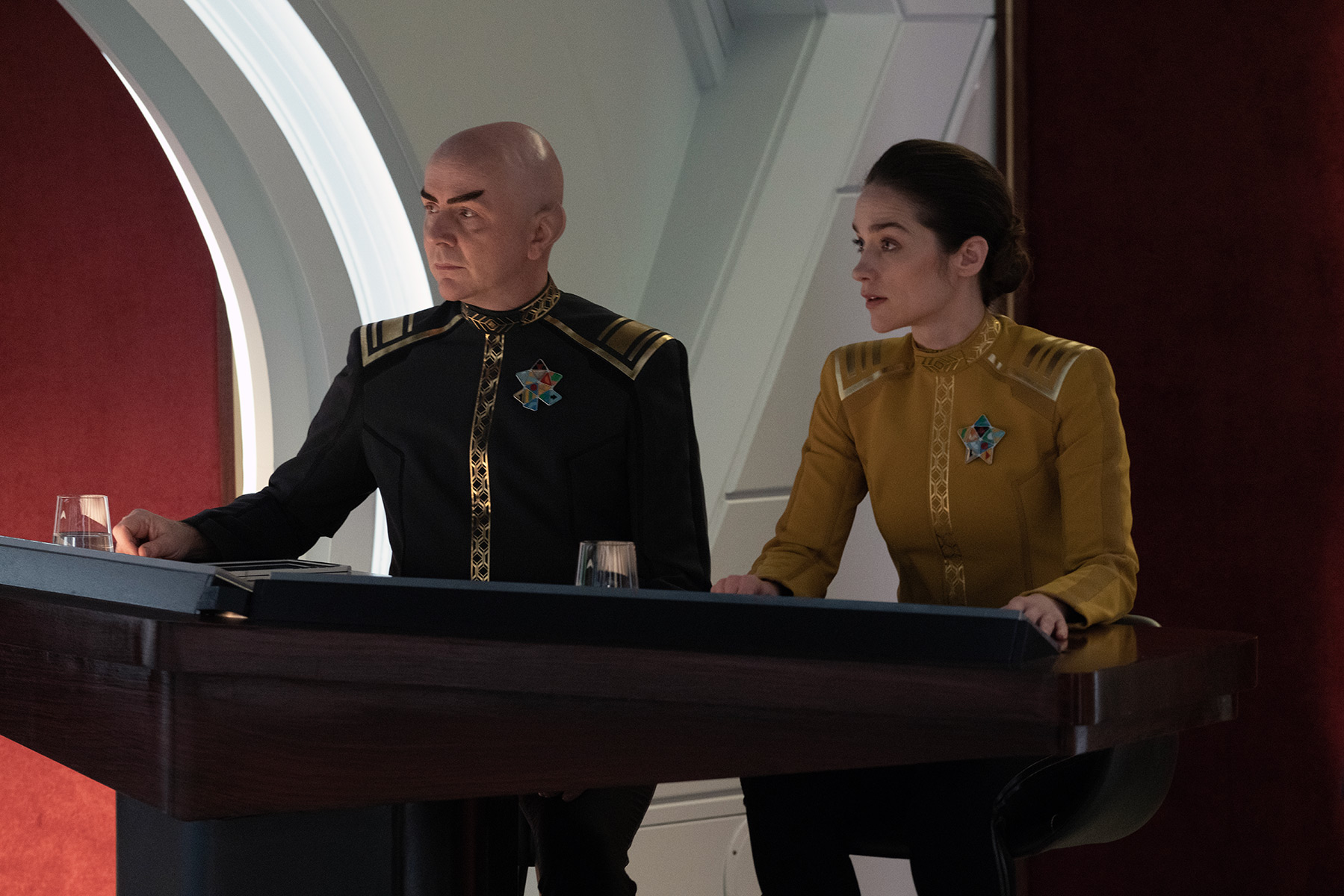
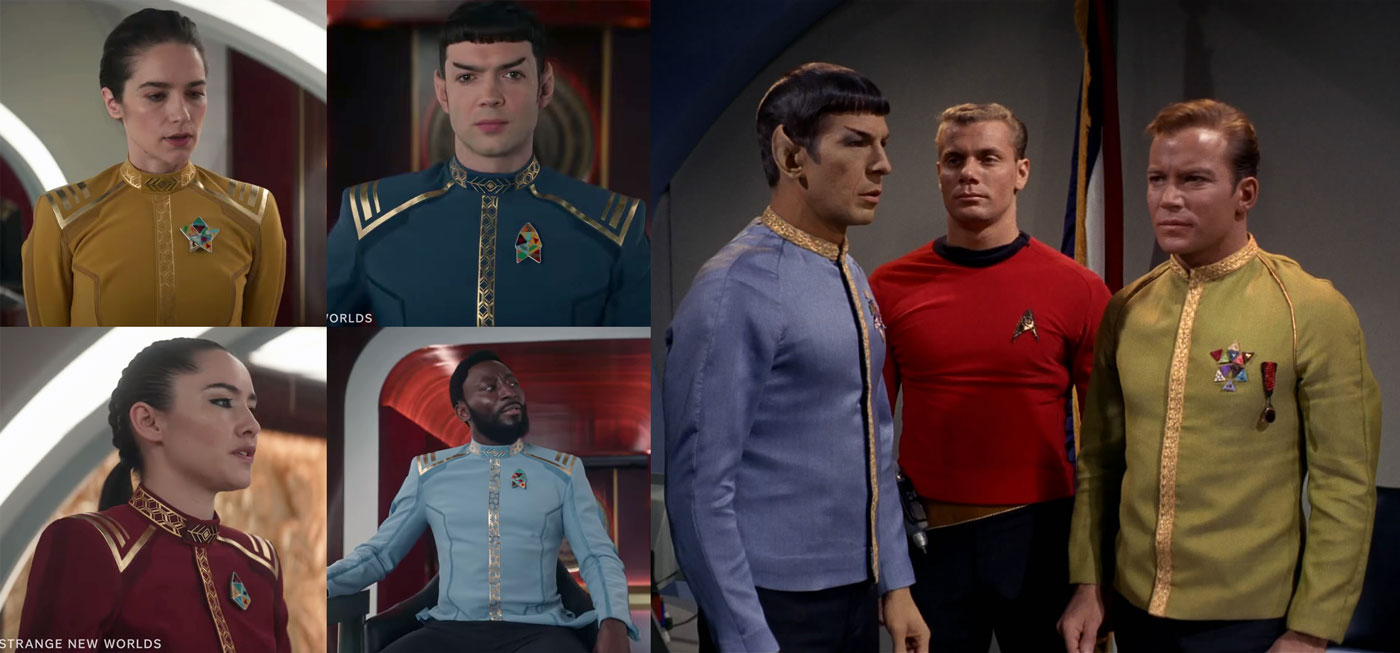
The trial sequences are dripping in the aesthetic retro-60s charm that we’ve grown to love from Strange New Worlds. The visuals of the golden bell, the ornate and masterful dress uniforms with clustered medals, and verifier scanner on the witness chair are all brilliant homages to the Original Series episode “Court Martial,” the genesis of the Star Trek courtroom episode. The case of immovable law against passionate counter-case also rings tonally of Kirk vs. the computer, but here the similarities end.
Neera goes directly for the intention of the law, reminding the judges (and viewers at home) that laws do not make justice on their own, and that civil rights history is a long struggle of moral right against legal might. The questioning and cross-examination of Admiral April (Adrian Holmes) is a masterful attack by Neera on Starfleet’s own well-discussed double standards on legal enforcements, with April’s repeated violations of General Order One contrasted with his reassessment of sponsoring Una’s Starfleet application.
It’s a heated scene, well-acted by Holmes and Badaki as April’s career is put in the spotlight, much to his irritation. Una is angry at Neera’s stunt too, even as her lawyer points out the privileged position, they both must make a stand for all Illyrians here. Is it just a soapbox to Neera? Possibly. It’s an interesting and difficult question, made even more pointed by the question of whether or not Una is leaving the rest of her people behind by making the case just about herself.
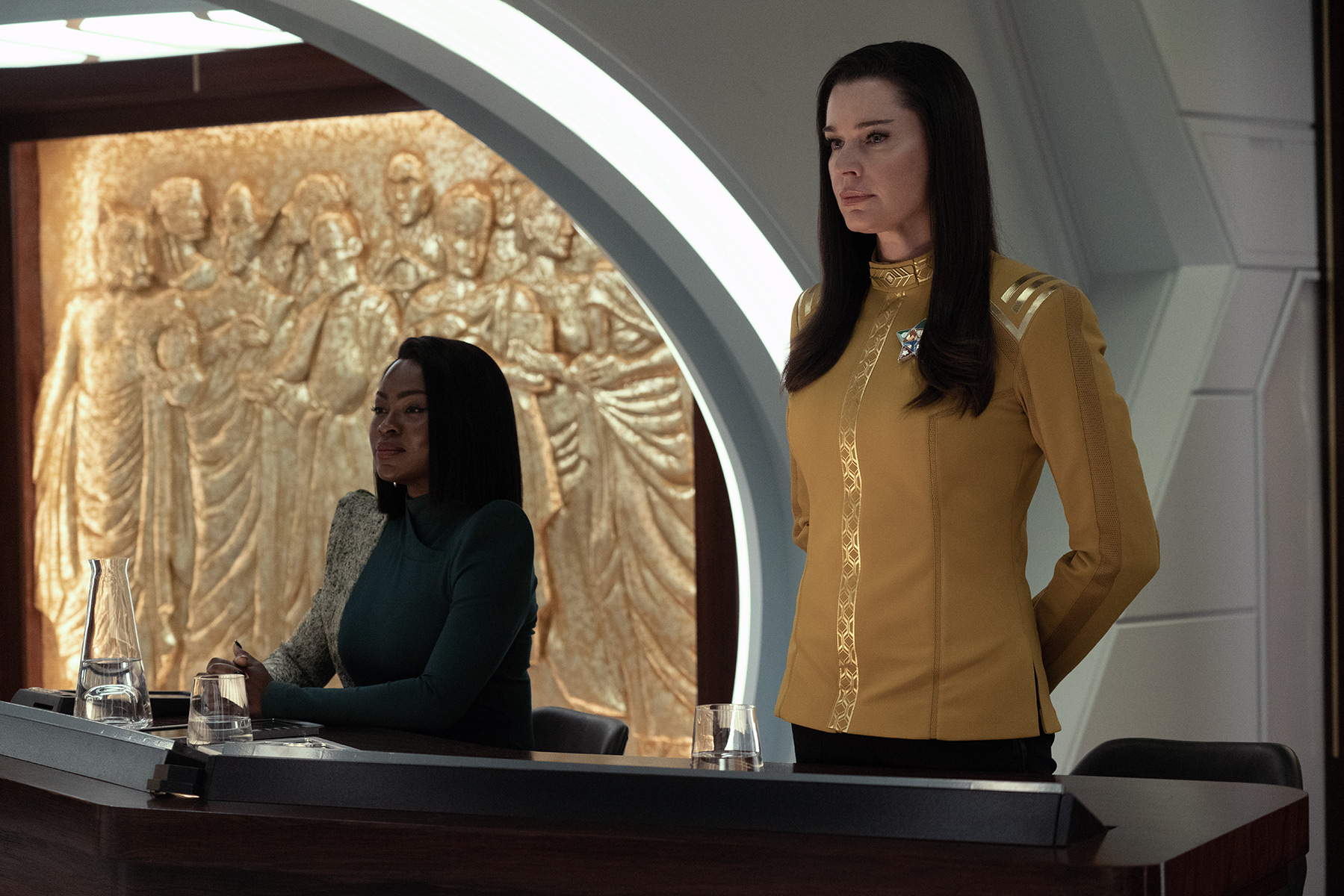
The character witness sequences with La’an, Spock (Ethan Peck) and M’Benga(Babs Olosanmokun) are a further delight, and not just because of their dress uniforms. All three offer unique defenses of Number One, with La’an’s mentor relationship a special highlight. Una — who saved her from the Gorn and encouraged her to join Starfleet and do good — is family. We even get a classic “Spock counters your logic with better logic” moment, when he argues that convicting Una would be a net loss to Starfleet: a naturally illogical action.
Once again, Strange New Worlds takes advantage of and uses it’s long-term serialisation for good here: we’ve seen how exactly La’an felt about the revelation in the first moment, but that the full-throated defence and belief in Una now feels like a graceful and well-earned full circle moment. The subsequent scene where Neera confronts Noonien-Singh about her own suspicion — that her own heated private log condemned Una — does mix the metaphors a little, allegory wise, but it still delivers the crucial message around not being ashamed of who you are, and who you are is defined only by who you are.
Una’s deposition is the cornerstone of the episode, and a stellar performance by Romjin and Badaki. It pulls no punches in its descriptions of Una’s childhood as part of a Federation colony in the Voltara Nebula, where the Illyrian community she was a part of was marginalized and oppressed by Federation law and society; their customs eroded, the families arrested and harassed and community divided. The description of her own brush with death, caused by the fear of exposure by an unsympathetic doctor, was tied with flashbacks throughout the episode, The breakup of her community and the pain that caused is clear; the ghettoization of the Illyrian community splitting families and friendships apart.
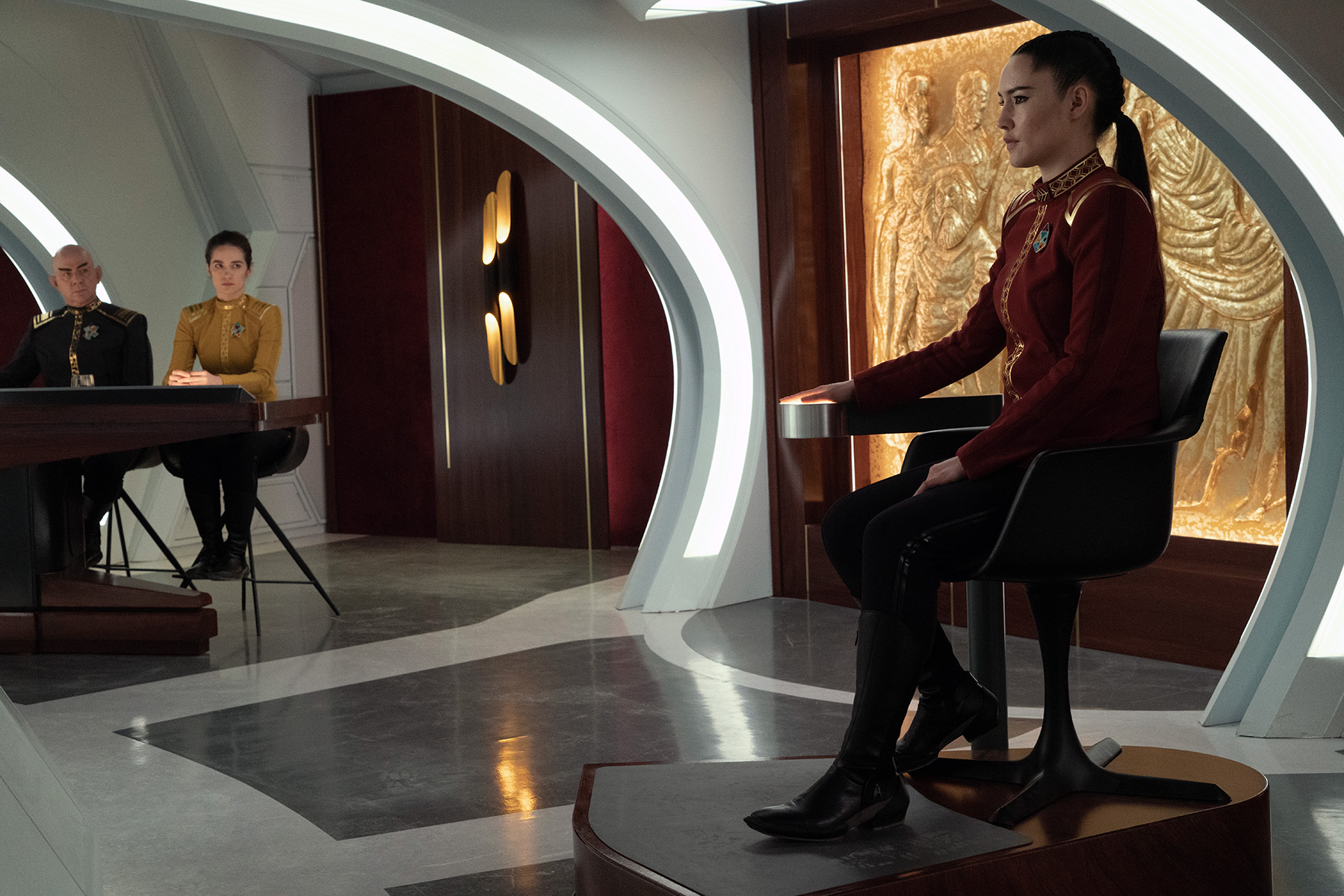
The fact that Una’s family escaped the tyranny of “separate but equal” is not lost on us or the characters, and her open admission that her family had the privilege to “pass” as unmodified — alongside her apology to Neera — speaks to a distinct understanding from the writer’s room of how difficult a choice passing has been for marginalized communities, where it is racial, religious, sexual or gender based persecution that they are trying to escape.
The killer blow of the sequence is the revelation that Una turned herself in. She was tired of living a lie and pretending to be someone else; of hiding her heritage. It was more important to her that her friends knew who she really was. She believed the Starfleet would accept her, despite the obvious ramifications; and that the organizations constant striving to be better than itself would see her through. “Ad Astra per Aspera,” indeed. It is a mission statement about what Starfleet (and the franchise itself) is all about: delivering ourselves from hardship to the stars, and the belief in a better world to come, and of the possibility of our salvation.
Admiral Pasik is, unimpressed, however. The law is the law, and the facts imply that Pike has been involved in a grand conspiracy to cover up a crime, as he knew about Una’s heritage for a long time beforehand. However, Neera uses this fact to present a new and unique counter-case. Citing Starfleet Code 8514, she argues that the three principles of asylum-seeking law in the Federation — clear persecution, seeking safety within Starfleet care and revealing themselves to an authority — have been met. Furthermore, that Pike’s acceptance and the current tribunal both vindicate the legal grounds necessary to vindicate and legalize Una’s position within Starfleet.
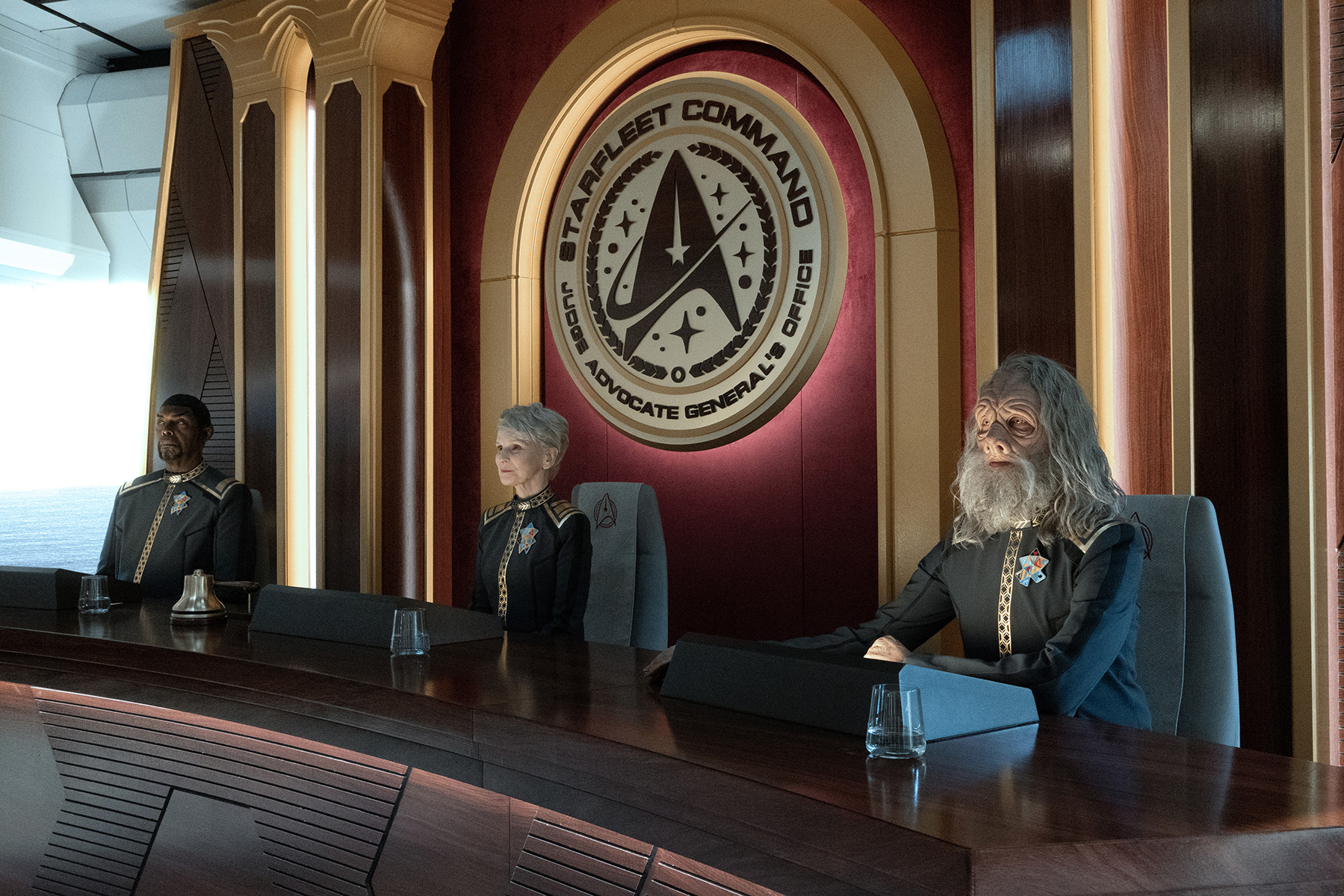
The judgement call of a Starfleet captain — the loophole that Neera used to attack April — comes back to save the day, as she appeals to the judges to “be their better selves” and understand the idealism of the law. Which of course they do, but not without the acknowledgement that despite the questioning nature of the law, there are clear individual cases to be considered. Therefore, Una will be granted asylum alongside a not guilty charge. Like almost all real work legal cases, it is an unhappy compromise.
But Una returns to the Enterprise to the joy of everyone involved, as Neera acknowledges that the case — and the proud crew — might not be the game changer for Illyrian rights… but at least it’s a step in the right direction.
CAMP NONSENSE OF THE WEEK
This week’s camp nonsense goes to the heated (by Vulcan standards) conversation between Spock and Vice Admiral Pasik, as M’Benga and Ortegas (Melissa Navia) observe from afar. It’s always about the subtlety with Vulcans, isn’t it?
OBSERVATION LOUNGE
- The updated dress uniforms include rank tabs on the shoulders and a redesign of the triangular medal clusters introduced in the Original Series dress uniforms, but they retain the fabulous golden piping. It also confirms that the grey-black uniform April wears is a staff officer’s uniform, used by Admiralty personnel.
- We see the return of a “Space Command Representative”, even if we still have no idea what that means. As Memory Alpha describes the early days of TOS jargon, “the terms “Star Service” and “Spacefleet Command” were later used in “The Conscience of the King” and “The Squire of Gothos” respectively, prior to the initial airing of “Court Martial.” Another early variant of the organization’s name was “Space Central” in “Miri.”
- Neera is presented with, and then uses as a prop in the courtroom, a physical copy of the Starfleet Uniform Code: something the great Samuel T. Cogley would be proud of!
- The courtroom itself is a redress of the Federation Headquarters set from Star Trek: Discovery.
- This episode gives us the first showing of San Francisco, home of Starfleet Command, in Strange New Worlds; one establishing shot even shares similarities with the establishing shot from Star Trek: The Motion Picture. (We last saw the city during this era in the Season 2 finale of Discovery, “Such Sweet Sorrow, Part 2.”)
- Captain Batel’s service as the prosecution lawyer mirrors the assignments of Picard, Sisko and others as advocates — hough why the captain of an active Starship is needed to perform this duty at Starfleet Headquarters, home to presumably several dozen other Starfleet lawyers is beyond me.
- Una joined Starfleet 25 years ago, which would date her entry into the academy to 2235. The fact that Pike addressed her Academy class would meet they met in the late 2230s/early 2240s — which fits with Discovery’s presentation of Pike joining Starfleet in the mid-2220s. (This doesn’t quite cover explain how he’d still be a lieutenant in the late 2240s, but we’ll save the question of Pike’s career stagnation for another time).
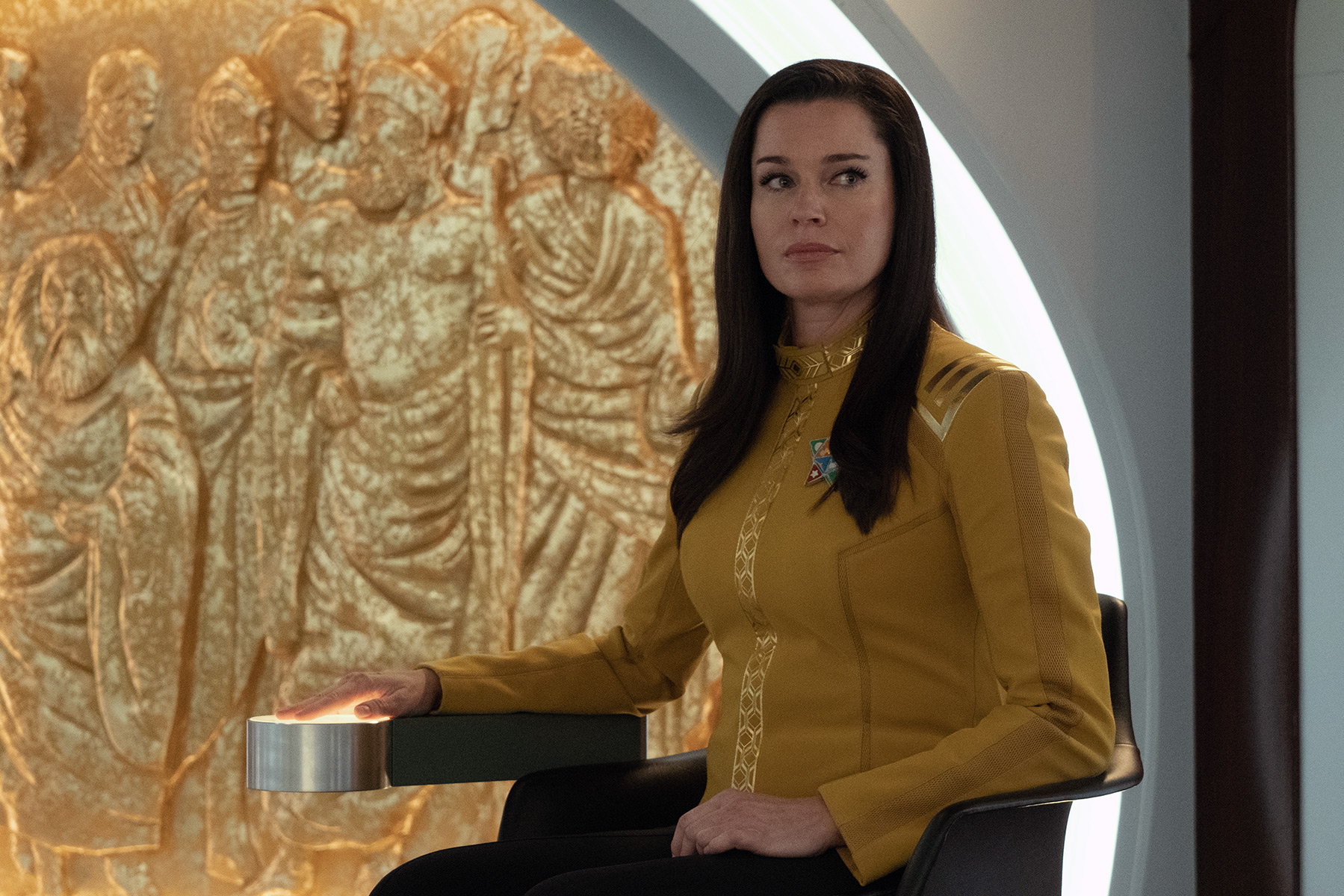
“Ad Astra per Aspera” is a well written, well-acted and deeply enjoyable episode that unavoidably speaks to the critical issues of our time. I’m sure plenty of people on social media, and perhaps in the comment section below, are going to blithely pretend this episode was about something other than LGBT rights. (Sure, and maybe “Let That Be Your Last Battlefield” was about the plight of French Huguenots.)
The llyrian allegory may be an allegory, but all know what this is about. This is about the frightening pace of social conservatism, and the increasingly dangerous world in which queer people — and especially trans people — live in.
The descriptions of Una’s childhood persecution — slurs daubed on doors, restaurants turning people away, playground insults, exclusion from medical care and the dissolution of communities as people seek safety from oppression are not distant possibilities — these are the real and lived lives of trans people of all ages across the world. The questions of hiding your identity in your workplace, of hiding your true self from your friends and loved ones: these aren’t arbitrary concepts: it is the terrifying reality for millions across the globe.
The flashback of young Una’s parents worrying about whether the wrong doctor will turn them and their child over to the state isn’t fiction for many families across the United States; it is now a terrifying reality we cannot afford to ignore.
Making a point about wrong that is, and how we should be better than that is exactly what Star Trek should be doing every single time it comes on screen, and I challenge anyone to tell me how confronting bigotry would go against the original mission statement of this franchise. Strange New Worlds releasing this episode in the middle of a pride month that — on both sides of the Atlantic — has been scarred by an increase in social and political bigotry aimed at LGBT communities is not an accident. It is not intended to make you consider what your position is, or to show you “both sides” of the coin. It is a call to arms, and reminder that Trek is about that struggle through adversity to the stars.
It is not a perfect story. There was an opportunity to put overtly queer relationships or characters on screen, and that choice wasn’t taken. Adding that element into the dynamics would have sealed this episode for me, and that omission does begin to tell the more I think about it. The confused nature of the Augment allegory — portrayed as villainous despots in “Space Seed” and the three-episode Star Trek: EnterpriseAugment arc, while analogous for marginalised communities in Strange New Worlds (and, arguably, with Julian Bashir in Deep Space Nine) — doesn’t help either.
I can see how re-interpreting them as an allegory for queerness works, but at the end of the day, it’s not really a substitute for proper representation — which still remains lacking in the Trek franchise outside of Star Trek: Discovery. With that show coming to a close early next year, the franchise will be carried by Strange New Worlds, as will the mantle of full-throated representation the show is noticeably avoiding.
This doesn’t mean I think this is a bad episode, of course; I just think that these decisions kept a great episode from becoming a stand-out one. I am sure in a year, or five years, or maybe in fifty, we will view this episode with the side-eye which which we view the Original Series’ ham-fisted allegories. But when we look back with derision, it will be because we have become our better selves, despite all that is in our way — but for now, at least it’s a start.
Subscribe to:
Posts (Atom)